The Northern Christmas Salvo
Incorporating Weekly Notices, Sectional Appendices, and Northern Weekly Salvo
Published at Station House, Kents Bank, Lancashire-North-of-the-Sands, LA11 7BB email: paul.salveson@myphone.coop
No. 329 December 2025
Salveson’s half-nakedly political digest of railways, tripe and secessionist nonsense from Up North
Season’s Greetings from Kents Bank
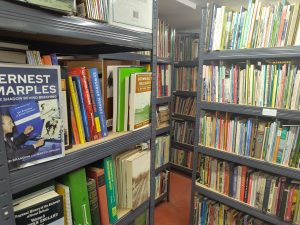
Warmest greetings for Christmas and the New Year from Kents Bank! We’ve had some very good news recently regarding awards – the Library has won the ‘Lancastrians’ award for its work, and we’ve been shortlisted in two categories for the national Community Rail Awards, being held in Derby next March (see below). Our Christmas Fair on December 13th went very well with the gallery, library and station
friends getting a lot of interest (and sales).
We’ve had some very welcome donations of books recently, including the final installment of the late Chris Gore’s library – a very big thank you to his widow, Debbie. We now have an extensive collection of books on overseas railways in our ‘browse and borrow’ section. The Library and Beach Hut Gallery will be closed from December 22nd until January 3rd. Have a great Christmas and New Year and hope to see you in 2026.
We’re looking for volunteers to help specifically with the library – it involves nothing more than a welcoming face for visitors, managing book sales, a bit of shelving and cataloguing and really just being there. If you’re interested, one day a month is fine, please het in touch.
Why no trains in Cumbria?
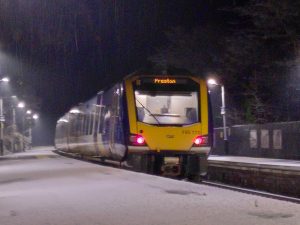
Severe weather was forecast on Sunday December 14th and Monday December 15th, with ‘amber’ warnings across Cumbria. As a result no Northern services ran on the Cumbrian Coast (Carlisle – Carnforth via Barrow), Oxenholme – Windermere, Lancaster – Skipton (Bentham Line) and Skipton – Carlisle (via Settle). However, West Coast Main

Line services (Avanti and TransPennine Express) did run from Preston to Glasgow via Shap. Presumably it was a decision taken with Network Rail, but if so, why permit trains to run via Shap but not via the S&C or Cumbrian Coast? Trains were running through Oxenholme but the Windermere branch was closed.
I’m not the only person to question the decision of Northern to run no trains in Cumbria, even though it won’t make me popular in some quarters for saying it. Sometimes you have to speak truth to power. I value having a good relationship with all the train companies, Northern above all as it’s ‘my’ operator having worked for it, used it and supported it through thick and thin over many years. Similarly with Network Rail. But blanket withdrawal of services on the basis of forecast bad weather (and not even a ‘red’ warning) isn’t something I can sit back and condone and ‘say nowt’. As it turned out, the rain was far less severe than forecast, though some areas e.g. Keswick and Ambleside, got a drenching.
The harm done to people’s daily lives was immense, to say nothing of the safety risk of people being forced to use their cars instead of the train. No immediate damage was done to railway infrastructure on Sunday and Monday though on Wednesday there was a landslip on the Cumbrian Coast Line, resulting in withdrawal of services north of Millom. However, this doesn’t justify the original decision – quite the opposite in fact. Selective speed restrictions (which appear to have been the case on the WCML for those two days) would have been a more sensible response combined with checks on locations known for problems. I don’t claim to be an expert on these things but generally, common sense would suggest that heavy rain has a less immediate effect on railways than on the highway network, with a more cumulative effect on railway embankments and cuttings, as shown by the recent events near Drigg.
A friend made the comment that “it shows how they shouldn’t rely on weather forecasts to cancel train services. There were no problems south of Corkickle when they stopped services for two days. Today (Wednesday), when all services were running, an actual landslide between Seascale and Drigg has stopped them! Far worse rain fell today than Sunday or Monday.”
I’m sure the decision of Northern and Network Rail management was taken in good faith by conscientious railway people whom I respect. But we can’t get into a situation when every time bad weather is forecast trains should stop running. It needs a measured response which balances the need to run a railway – with all the obvious benefits it brings – with safety. As things stand, the balance is far too much on being completely risk averse. There are always risks in running trains. The safest way to run a railway is not to run any trains at all. But the wider risks to society far outweigh those considerations. Sorry guys, it was the wrong decision.
Great British Railways: need for creative thinking in the regions
It’s an interesting time in railway politics. The establishment of the new state-owned entity – Great British Railways (GBR)– is gathering momentum, but don’t expect it to happen before 2027. However, several train operators have already gone into the state sector, now part of ‘Department for Transport Operations’ (DFTO). More will enter the state sector next year. The infrastructure body which owns and manages the rail network, Network Rail, has been publicly-owned
for several years. GBR will bring infrastructure and operations together, though the detail of how that will happen is still unclear.
The establishment of ‘Great British Railways’ should be an opportunity for some creative thinking within Labour and the progressive left about how a state-owned rail operator should work. Instead of thinking “job done, it’s all back in state ownership” it should be an opportunity to learn a few lessons from the last thirty years – and there are some – for how a truly publicly-owned railway could operate. Some operators, for example Merseyrail and Chiltern, have developed strong regional identities and become a part of the fabric of their communities.
It goes back, in part, to the classic quandary of how big should a rail operator be? Switzerland is a brilliant example of a state operator (SBB) working together with over fifty smaller regional operators, mostly owned by their local authorities. I remember chatting to the manager of a regional operator in Bern many years ago. He said “small is beautiful, but too small can be ugly”. He had a point. He might have added that “too big” can be ugly as well and that could be a risk that GBR runs if it doesn’t allow a degree of regional autonomy. That is already working with Merseyrail and the West Midlands and Greater Manchester are moving in a similar direction. There is scope for more developments in the established mayor authorities, such as West and South Yorkshire and the North-East.
However, there is scope for a more creative approach in areas not currently covered by the existing strategic mayoral authorities which learns some lessons from the community rail movement which has promoted a strong degree of local involvement combined with effective marketing. Cumbria (and North Lancs) offers an opportunity to try out a fresh approach which could work well within the umbrella of GBR. The Furness Railway was an example of Victorian regional enterprise, developing a network around what is perhaps best described as ‘The South Lakes’ today. It was admired by forward-thinking socialists like Bram Longstaffe, Labour mayor of Barrow, who regretted its merger into the giant LMSR in 1923, with consequent loss of local input. Longstaffe was a good friend of the general manager of the Furness from 1895, Alfred Aslett, who was a radical Liberal.
A modern-day Furness and Lakes Railway, serving the regional lines north of Lancaster to Morecambe, Barrow, Windermere and round the coast to Whitehaven, Workington and Carlisle, would be big enough to work in operational terms but small enough to be close to a large market for both tourists and local people. It could be a test bed for a unified
regional operation, with operations and infrastructure coming under a single manager, part of GBR but with substantial devolved responsibilities. It could have a strong regional brand identity and build strong links with the local business community – particularly tourism – but also major employers such as Sellafield and BaE in Barrow. By being ultimately part of the national GBR structure it could pull in major resources for infrastructure repair and development whilst focusing on the day-to-day infrastructure management.
This ‘Furness and Lakes Railway’ could have a management board involving the local authorities, trades unions and community/business interests bringing real local control to the railway. As the railway expanded its business It would bring good quality jobs to an area which offers few opportunities apart from Sellafield and BaE. The proposed establishment of a mayoral authority for Cumbria would offer further potential and long-term scope to promote re-openings and new stations. The new Cumbria authority is likely to have responsibilities for the bus network, offering scope for improved integration between rail and bus – not just in the ‘honeypots’ like Windermere, Penrith and Carlisle but also at places such as Barrow, Workington, Maryport and Whitehaven. A ‘Furness and Lakes Railway’ would have strong incentives to work as part of a wider integrated transport network across the area it covers.
None of this involves huge investment – but it does involve a leap in thinking. The concept isn’t only applicable to Cumbria; it could work in many parts of England outside the main conurbations. Your thoughts welcome, dear reader!
(PS: The recent goings-on in Cumbria – see above – may have had a different response from the proposed structure)
A Children’s story for Christmas – suitable for adults as well
This is a slightly edited version of a story which appeared in The Loco Vanishes. It was written for my grandchildren, who seemed to like it. It was suggested that it’s far too gloomy for Christmas, but I’ll leave you to be the judge. If you like it, try reading it to your kids or grandchildren (and let me know what they think of it).See if you can get your tongue round the dialect!
The Old Engine’s Last Journey
This is a story from a long time ago – 1960. It happened to a boy called Peter and a girl, Peter’s sister, called Mary. Peter was 11 and Mary was 8.
They lived in a town called Bolton. Back then it was still a very smoky, factory town that had lots of cotton mills. There were engineering factories too, and – not so far away – coal mines. Can you imagine that men used to dig underground for coal? They did, and it was a dangerous job.
The railways were very busy moving all sorts of things including cotton but much more. Next to the station at Bolton there was a huge warehouse where all the goods that had been made in Bolton were sorted and despatched all over the country – and beyond.
Sixty years ago most trains were hauled by steam locomotives, like the ones you see at Bury, on the East Lancashire Railway. But they weren’t lovingly polished with gleaming brass and copper. They looked a bit shabby and neglected. A few years later, in 1968, the last steam locomotives went to the scrapyard, replaced by diesels or electrics.
Peter and Mary lived in a small terraced house in a part of Bolton

called Great Lever, on Eustace Street- number 72. The house was like thousands more in Bolton and other Lancashire towns. Yes, Bolton was in Lancashire and people were very proud of that. Its symbol was a bright red rose. Probably more typical of towns like Bolton were the cobbled streets rather than roses, though some of the people who lived on Peter and Mary’s street were proud of their little gardens.
Their house had a small front garden and a yard at the back which used to have the outside toilet. The bath was an old metal tub that their mum brought out for bath time. The shed was where Peter and Mary’s dad used to mend things – he was very practical and loved nothing more than repairing old bikes and tools. He was what they called a tackler – a sort of engineer – and worked in Bee Hive Mill, just down at the bottom of the street. Mum, Joan, worked there as well, as a cotton spinner on the ‘ring frames’ that replaced the old spinning machines –
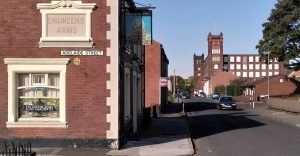
called ‘mules’ – which only men were allowed to operate! Most of the grown-ups on Eustace Street worked in the mills, though a few were railwaymen. Some women worked at the hospital as cleaners, or sometimes as nurses.
The street was surrounded by cotton mills, but the two Bee Hive mills were the biggest. They were six storeys high and towered over everything; you could see the towers, with their fancy red brick, for miles. Next to them was the engine shed, on Crescent Road. It was home to over seventy locomotives – large and small, but mostly for goods traffic, shunting and local passenger trains.
Peter and Mary loved going on little adventures around the area they lived in. As well as brother and sister they were really good friends and didn’t often fall out.
Their Uncle Jack was a driver at the engine sheds; he’d started as young cleaner at the sheds in 1920 and became a driver just before the war started in 1939. Sometimes he’d give them both a ride up and down the sidings in the sheds, which was the most fabulous treat. “Don’t let anyone see you,” said Uncle Jack, “especially that miserable old foreman, Fred Horrocks – he’d have my guts for garters!”
Peter didn’t really know what he meant, except it was bad. Visitors weren’t welcome at the sheds. At the entrance was a large sign saying ‘Trespassers will be prosecuted’. Peter wasn’t sure what a ‘trespasser’ was either but the message seemed to be ‘Keep out’.
He knew a prayer they said at his school – St Williams – that said something about ‘forgive us our trespasses as we forgive those that trespass against us’ but wasn’t sure how that had anything to do with engine sheds.
Peter and Mary’s other playground was round the back of the Bee Hive mills – the mill lodge. It was a big reservoir full of water that used to feed the steam boilers that powered the mill engines – which drove the spinning mules. The old mill engines had been scrapped years ago but
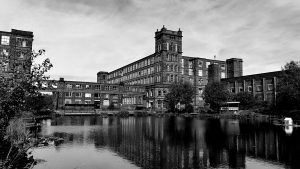
the mill lodges carried on – nobody knew what to do with them and some of the local fishermen (most worked in the mill) got permission to fish in them. You’d get all sorts – carp, bream and lots more. Like the engine sheds, it was strictly out of bounds.
Peter and Mary’s mum used to say “Durnt be goin’ near that mill lodge – it’s deep, ah durnt want either of yo’ drownin’!”
Like most children in the area, they ignored their mum’s advice and used to do a bit of fishing of their own, though they’d often get shouted at by the old gaffer in the mills.
“Aw’ll tell thi mother tha’s been playn’ bi th’lodge an’ tha’ll cop it!” he said in his broad Lancashire accent. “Ah know where tha lives y’know.” Mr Tatlock lived at number 84 on Eustace Street, so he would do.
Peter and Mary ran off and climbed over the mill wall to escape his wrath.
They carried on playing – and even caught a fish, sometimes.
…………………………………………………………………………………………………….
As Peter got a bit older he became more adventurous and realised you could sneak in to the back of the engine sheds through a hole in the fence. After a couple of forays he asked Mary if she’d like to come as well. To tell you the truth Mary was probably more daring than her brother and didn’t need any persuasion. All you had to do was squeeze through the hole and then jump down to the ground, a couple of feet – and you were in! It was a very special, secret place.
“Do you think we’ll be alright Peter?” Mary asked as they picked themselves up from the ground after jumping down from the fence.”You don’t think we’ll get prosecuted?”
“No, I don’t think so -,” said Peter, “nobody ever comes round the back of the sheds, we’ll be safe.”
Near to the fence – and the hole in it – there was a siding which was used for storing old engines which were waiting to go to the scrapyard, at Horwich Loco Works, just a few miles away.
They’d seen an old engine dumped at the end of the siding for a few months but it took them a while to get the courage to explore it
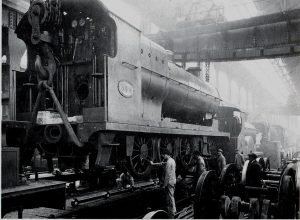
properly. It had a number on its side – 50647 – and you could make out the name ‘British Railways’ on the locomotive’s tank.
The engine was very old – it had been built at Horwich in 1890 and had been at Bolton shed for most of its life, working passenger trains to Rochdale and Wigan and – in its old age – shunting wagons and vans at Bolton station. The railwaymen called it ‘A Radial Tank’ and were very fond of it. Everyone was sad when it was finally put on the scrap line.
…………………………………………………………………….
It was Mary who suggested they should climb into the cab. It was a Sunday afternoon and nobody was about.
Once they were in the cab they were both very excited.
“Let’s play drivers and firemen!” said Peter. “I’ll be the driver, you be the fireman.”
“Why can’t I be the driver?” asked Mary.
“Drivers are only boys – or men, and even firemen are men so you’re very lucky to be asked…and besides, I’m older than you.”
“Well it’s not very fair,” sulked Mary. “But let’s get on with it.”
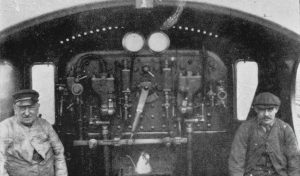
Peter sat on the driver’s seat and opened the regulator, a large handle which controlled the steam entering the cylinders. He’d seen his Uncle Jack do this, when he gave him a ride in the cab, up and down the shed yard.
Mary found an old shovel that had been thrown away in some weeds, near the buffer stops at the end of the sidings. It was heavy to carry, but she managed to lift it into the cab.
“Are you ready Mary?” Peter shouted across the cab. “Get shovelling, we’re going to London on the afternoon express and we’ve got to keep time!”
Peter opened the regulator as far as it would go and Mary pretended to shovel coal into the old engine’s firebox. He pulled the cord which made the whistle peep – if there was any steam in the boiler!
They started coming every Sunday playing on the old engine, pretending they were on an express to London, Cornwall or Scotland.
“When am I going to drive?” said Mary.
“When you’re old enough,” said Peter. “Uncle Jack said you have to be a fireman for thirty years before you can be a proper driver, so you’ve a long time to wait.”
………………………………………………………………………..
One day Peter had an idea.
“Our engine really needs a bit of a clean. It’s covered in dirt and rust. Let’s get some old rags and give it a polish.”
So they found some old rags in their dad’s shed and some oil as well that could clean off some of the filth on 50647.
 After a few attempts old 50647 was starting to look quite smart. Peter found some white paint and painted the number on the front of the engine, the smokebox door, and the shedplate – ‘26C’, the code for Bolton.
“That’s better,” said Peter. “It looks like a proper express engine now, ready to go to London!”
…………………………………………………………………………
A few months later it was Christmas. The mills had closed down and most of the engines had been put into the shed, ready to start work again after the holiday.
It was bitterly cold and all the mill lodges had frozen over.
Peter and Mary were looking forward to their Christmas Day dinner, with turkey and Christmas pudding.
“Let’s go down to the lodge first and do a bit of skating! The gaffer’ll be off work and nobody’ll see us.”
They skated all round the lodge, and nobody shouted at them to stop. They went faster, and faster, and faster. Both of them felt dizzy but couldn’t stop. Someone shouted out “be careful, the ice has melted by the boiler house.” Mary got a bit frightened and called to Peter “Can we stop now?” but they carried on, almost in a dream.
Peter said “come on Mary, let’s go and see our engine and wish her merry Christmas!”
There was a secret way in to the back of the engine shed from the mill, used by engine drivers taking a short cut to and from work.
They got to where ‘their’ engine was standing. It seemed to have gone dark very early but they didn’t worry about their Christmas dinner – this was more exciting.
“Peter, look! There’s steam coming from her!”
And sure enough, the steam valves of old 50647 were sizzling
“Let’s get on, come on Mary,” Peter urged.
Once they got into the cab they couldn’t believe their luck. There was a fire blazing away in the firebox and steam pressure was showing 150 lbs. per square inch, enough to get moving.
“Get some more coal on Mary,” we’re going for a run! London here we come!”
Peter put the reversing lever into the ‘forward’ position and eased off the brake. She moved easily. Peter pulled open the regulator and the engine puffed along the siding, towards the points at the top of the shed yard, controlling access onto the main line.
He blew on the whistle as he approached the points.
“Is the signal clear for us, Mary?” Peter shouted across the cab to his fireman.
“Yes, the signal’s off, we’re right away for the main line!” Mary had picked up enough railway talk from Peter and Uncle Jack to know the proper language…
The engine veered out onto the main line, heading northwards towards Bolton station.
It was completely dark by now and they couldn’t see anyone in the signalbox at Burnden Junction, or at the next one, Bolton East Junction. It was as though everyone had gone to sleep.
They steamed through the station but again, there was nobody on the platform – no passengers, no porters nor anyone.
The signal was clear for them to proceed, over the junction and on
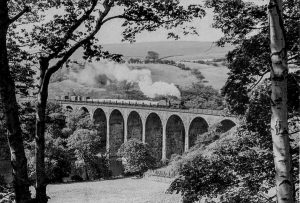
towards Blackburn. Up the long steep climb to Entwistle, high up on the moors – and into the long murky Sough Tunnel before Darwen.
They went over the long viaduct across the River Croal and the canal and past the gasworks.
“This is great, isn’t it Mary! I’ve always wanted to do this – always, always, always…and I’ve got the best fireman – or firegirl – in the world!”
The engine picked up speed and went past Astley Bridge Junction Signal box, high up on the Tonge Viaduct. No sign of anyone in the box but the signals were all clear for them. They looked out from the cab and saw rows of houses, just like Eustace Street. Further away they could see the cotton mills, but none of the chimneys were smoking. And further away still, the clock of the town hall and the parish church.
It was a bright, moonlit Christmas night and they puffed along at increasing speed, Peter pulling back the reversing lever – a bit like the
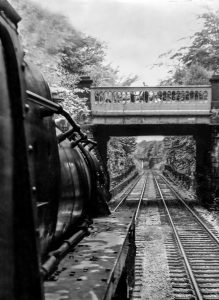
gears on a bike – as they accelerated. They steamed past the little station and signalbox at Bromley Cross and there was snow on the ground. The station lights made a shadow of the engine on the snow-covered tracks.
Peter opened the regulator of 50647 as they continued the climb towards the tunnel. By the time they reached the bridge at Turton Tower, with the old turrets on the bridge, the tracks were completely covered with snow.
They went over the level crossing by the towel mill and carried on, through open fields towards Entwistle. In a short while they passed over the big viaduct, looking down to the reservoirs, with the moon reflected in the waters.
Entwistle station was, like all the others, quiet with no sign of anyone in the signalbox, perched above the tracks.
“We’re nearly at the top now, Mary.” You don’t need to shovel any more coal on.”
“Good, I’m tired out,” she said. “I need a long rest…”
They passed the signalbox – Walton’s Siding – at the summit of the climb and started to drop down towards the tunnel mouth. Peter closed the regulator, shutting off steam.
They entered the tunnel at about 45 mph.
Then it started to happen.
Gradually a white light covered the engine cab and the whole of the tunnel. It got brighter, and brighter, and brighter. They could hardly see anything for the brightness, just the fire in the engine’s firebox.
Peter and Mary leant across the cab towards each other, their hands reaching out to each other’s. Their fingers lightly touched.
“Stay with me Mary,” Peter said.
“Course I will, a good fireman never deserts her driver.”
……………………………………………………………………………..
There was no newspaper the following day but the headlines of The Bolton Evening News for December 27th were full of a big local story.
“Terrible Christmas Day Tragedy – children drowned in mill lodge”
The report continued:
A Christmas Day skating adventure turned into tragedy for Bolton children Peter Haslam (11) and his sister Mary (8). A thin sheet of ice cracked under the children’s weight and both children fell into the freezing water. It is thought that death was instantaneous….the children’s bodies were discovered with them holding each other’s hands.
A police spokesman said “This terrible tragedy underlines the importance of children staying away from mills lodges. This is not the first time this has happened in Bolton but it must be the last.”
………………………………………………………………………………………………………………
It was two days later that Bill Hartley and Tommy Frost signed on at the sheds for a special job at 8.30 in the morning.
“Tek that owd demick 50647 on th’siding road to Horwich for scrap,“ said Fred Horrocks, the shed foreman. ” You’ve loco 2626 on Road number 6 to drag it. Jack Haslam’s spare so he’ll act as guard. And be good wi’ him, you’ll have heard what happened to his niece and nephew. He were very close to ‘em.”
The crew found Jack in the messroom with a full cup of tea.
Nobody knew what to say but both men put their arms round Jack in a rough but kind show of sympathy.
“Let’s get this job done,” said Bill. “An’ we can aw get finished an’ goo whom.”
They got steam up on 2626 and eased off down the shed yard and reversed into the siding to collect the old engine, to make its last journey to the scrapyard.
Tommy jumped down to couple up the engine and ‘got in between the two engines. He’d been told it might be a job to get the engine moving – it had been stood outside for six.
Yet there was something strange about the old engine.
“Are you sure this hasn’t moved for six months?” Tommy shouted up to his driver.
“Aye, that’s what Horrocks towd me, it’s bin on th’scrap road for months.”
“Well this engine’s bin someweer – th’ rails under th’ wheels aren’t rusty. It’s bin movin’, for bloody sure.”
“An’ here’s summat else for Horrocks to chew on,” shouted Tommy. “That firebox is warm. It’s bin in steam not long agoo. Two days at th’most. What d’you mek o’that?”
Day out to Dumfries
I had a very enjoyable day out to Dumfries recently on the invitation of my good friend and Scotrail community ambassador John Yellowlees. I was delighted to meet up with some members of DARG (Dumfries Adoptive Gardeners) and see their wonderful display (even in December). Their museum is a delight and the station cafe next door is fantastic, run by Daniel who hails from Ethiopia. I can recommend the haggis barm cakes (buns). Ann Roberts has kindly drafted this short article about the work of DARG:
Dumfries Adoptive Railway Gardeners (DARG) is a group of gardeners who look after the grounds at Dumfries Railway Station as part of the ScotRail Adopt a Station scheme. We were constituted in
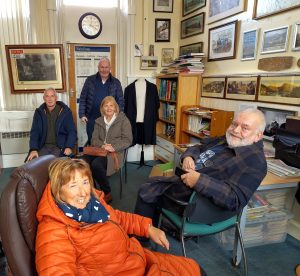
2019 following on from a previous gardening group at the station and we’re a group of nine retirees , meeting on a Monday morning from about March through to December.
The main Glasgow-Carlisle line runs through Dumfries Station and there are two platforms. There is garden ground at both platforms. The grounds have been planted up in distinct areas depending on the soil and aspect.
Platform 2 is sloping down towards the track. It is laid to lawn primarily with a bed in the centre with DUMFRIES marked out in box hedging. The far end of this garden is laid out with cornus bushes which provide variegated leaves in the summer and bright red and
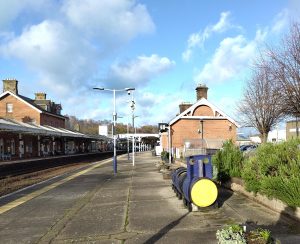
orange bare stems through the winter providing some colour all year. At the car park side, the area is surrounded by metal railings beside which is a long bed of perennials and bulbs. At the other end we now have a small bench surrounded by fragrant perennials in the summer. There is access to the lawn through a gate by the station buildings so that passengers and public can sit on the bench and makes for easier and safe access for gardening. The recent coronation and the reign of Queen Elizabeth 2nd is commemorated by two shrubs.
On the platform itself is a blue painted wooden train made from whisky barrels, provided by ScotRail, and several planters filled with orange geums and purple salvias which last through from Spring to Autumn. In the Spring they are bright with daffodils and muscari.
The main garden area is on Platform 1. There are two sheds, both listed buildings, within the garden, one of which is used by DARG. The ground is divided up into several smaller ‘gardens’ depending on aspect and soil type.
Firstly, the Wishing Well Garden, a lawned area bordered by herbaceous beds containing lupins, everlasting geraniums and monarda to name a few. It also contains a wooden Wishing Well. Next is the Dry Gravel Garden, containing various grasses which provide height and movement. Further along is the Rose Garden planted with scented rose bushes and lavender and has a seat donated by the Breathing Space mental health charity.
There is a very large, old red horse chestnut tree on the sloping area leading up to the road bridge so DARG, with the help of several local supporters has created a Fairy Garden under it for wee ones to visit. Comprising several ‘fairy houses’, doors and toadstools, it is popular with one of the local day nurseries.
This year DARG adopted two further pieces of railway land. A derelict, weed and rat infested area beside the main car park has been cleared, planted with azaleas, daffodils and four thousand purple crocus bulbs and named The Shrubbery, it should be very colourful in the Spring. Two narrow beds running along each platform were formerly adopted by Incredible Edibles growing fruit bushes and vegetables – these have been given back and are now planted with azaleas, heathers and bulbs.
DARG has been involved with Keep Scotland Beautiful for many years and is proud to have achieved its Level 5 and Certificate of Distinction. We have participated in the Annual ScotRail in the Community Awards and have been honoured to win Adopted Station of the Year amongst others.
Conservation and environmental responsibility is important to the group. This is demonstrated by installing water butts to assist with watering in summer; creating compost bins working on a three year cycle; using shrubs and perennials within the garden rather than annuals; using pollinator friendly plants and installing bird nest boxes and feeders.
The garden is regularly used by passengers and members of the public as a spot to wait for a train, enjoy a picnic lunch or a bit of quiet space. When we are working people frequently stop to chat and compliment us on the gardens as do some of the train crews. To see photographs of the garden and to see what we have been doing, there is a Facebook page – Dumfries Adoptive Railway Gardeners – DARG.
I do hope that some of your members could pay us a visit – we would love to show you round.
Awash with awards
Kents Bank Station Library has been honoured with the prestigious ‘Lancastrian Award 2025’, covering the area traditionally known as ‘Lancashire North of the Sands’. This recognition celebrates the Library’s dedication to the North’s railway heritage and history. In addition it has been shortlisted for two entries in the national Community Rail Awards for 2026, which will be held in Derby in March.
Since its opening in January 2024, the Library has welcomed visitors
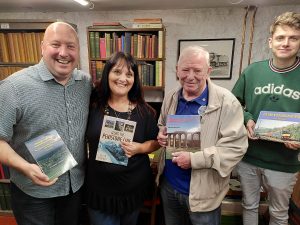
from across the region and beyond. Guests can explore an extensive collection of railway books on aspects of railway and wider transport history, enjoy a growing lending section, and browse books and model railway equipment for sale.
The library hosts regular exhibitions, informal talks at the ‘Mutual Improvement Class’, poetry readings and offers complimentary teas and coffee at the pop-up station buffet. It recently published a collection of railway ghost stories, set in the North-West (‘The Loco Vanishes – Northern Rail Mysteries’).
Prof. Paul Salveson, manager of the Library (a community interest company run by volunteers) said “We are really thrilled to receive this recognition. Kents Bank was part of the ancient North Lonsdale Hundred and remains part of the historic County Palatine of Lancashire, though it transferred to the administrative area of Cumbria in 1974 and more recently became part of Westmorland and Furness Council. Many local people, as well as visitors from Grange, Ulverston, Barrow, Broughton and surrounding communities still strongly identify as Lancastrians. But we welcome visitors from anywhere and everywhere,” he added. “Recently we have had visitors from Budapest, the Isle of Skye and Switzerland!”
Kents Bank is a wonderful destination—whether walking or taking the train from Grange-over-Sands. Visitors can also enjoy the beautiful station gardens and the stunning artwork at the neighbouring Beach Hut Gallery.
Friends of Real Lancashire said, “This award is a testament to the v
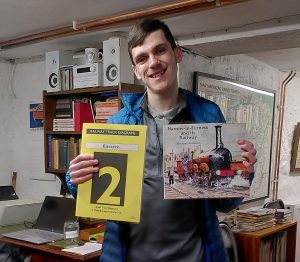
ibrant community that supports Kents Bank Station Library. We hope this award will entice even more visitors in the future! Congratulations to everyone at Kents Bank Station Library.”
The Library, and adjoining The Beach Hut Gallery, is open Friday to Monday 11.00 to 16.00, until closing for the holiday on December 22nd. The Library and Gallery are holding their Christmas Fair on Saturday December 13th, from 11.00 to 16.00. “We invite everyone, Lancastrians, Cumbrians, Yorkshire folk and neighbours from Westmorland to come along and see what’s on offer at our wonderful place,” said Paul
Railway cats, ghosts and other stuff
The collection of short stories with an ever-so-slightly supernatural twist is now available and selling pretty well. The Loco Vanishes – Northern Rail Mysteries is published by Kents Bank Station Library price £9.95. It includes a very kind foreword by Mick Whelan, general secretary of ASLEF, as well as endorsements by Phil James of Network Rail and the acclaimed railway novelist Andrew Martin. Mick Whelan said: “Paul’s knowledge of and love for the railway shines through both in the construction of the stories and also by introducing the reader to a world of which they would normally be unaware.”
Phil James, Managing Director of Network Rail’s North-West route said: “Paul’s stories capture the spirit of railway life in a way that’s both deeply
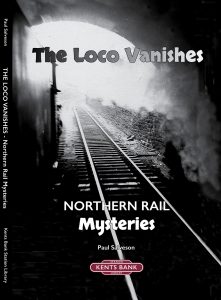
personal and universally relatable. As someone who’s spent a career in rail, I see in these tales the humour, grit, and humanity that define our industry. From the signalbox to the supernatural, this book is a celebration of the people and places that make the railway—and the North—so special.”
There are ten stories in all, mostly set in the Bolton, Blackburn and North Lancashire area, including Kents Bank. ‘The Crossing Keeper’s Cat’ is set in and around Oxenholme. Many of the stories are based on tales I picked up when I worked on the railways, including the title story, based on an event which happened at Plodder Lane loco shed, Farnworth, probably in the late 1940s. ‘The Boggart of Kitson Wood Tunnel’ is also based on a true story from the 1960s.
The book is kindly sponsored by ASLEF and Furness Line Action Group. Details on the Station Library website: www.stationlibrary.org.uk or email me your email address and I’ll send you further details.
Books for holiday reading
The Library continues to get a selection of new books for review. Usually, we don’t have sufficient space in The Salvo or the Library news updates to do them justice but hopefully the following will whet your appetite.
The Liberation Line – the last untold story of the Normandy Landings Christian Wolmar
Wolmar has excelled himself with this story of the railway’s – and railway workers’ – contribution to the Normandy Landings and what
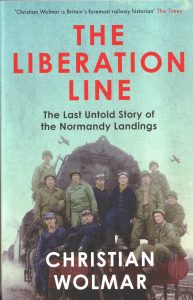
ultimately led to the Allied victory over the Nazis. There is so much in this that will be new to most Salvo readers and it’s difficult to single out particular highlights. What I would say, the contribution of American soldiers – many of them railroad workers in their civilian roles – was immense. Another interesting, and related, fact is that the main US railroads helped to organize the squads of GIs, so for example the Union Pacific RR had its own Railway Operating Battalion. The Pennsylvania RR and Baltimore and Ohio also played major roles in the reconstruction of Northern France’s railway network, often while lines were still within shell and even rifle range of the Germans.The French Resistance played a massive part in defeating the Nazis, often at a very high cost. Many French cheminots were members of the Resistance and the communist-led union, the CGT, played a particularly heroic part. Published by Atlantic Books price £12.99
For the Love of Trains Paul Routledge
Paul has written a lovely book about his own ‘love of trains’. Needless to say, it’s a good read (He has spent a lifetime in journalism, much of it with The Daily Mirror). It combines a potted history of Britain’s railways with a sharp political eye for the post-war railway, including Beeching, privatisation and the battle to save the Settle-Carlisle Line. Paul was brought up in a railway community (Normanton) and that helps inform his understanding of railways. As a lifelong socialist he 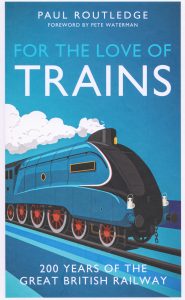 makes sure that the contribution of Britain’s railway workers figures large in the narrative. He’s also a self-confessed ‘puffer nutter’ with a particular penchant for narrow-gauge railways. Nice to see that top of his ‘Top 10 Great Little Trains’ is the Ravenglass and Eskdale, with the miniature North Bay Railway in Scarbrough coming second (he’s also a typical Yorkshireman…). A nice book to snuggle down to on a Winter’s evening. I pretty much read it in one, go, but may return for a longer savouring, possibly over a pint of Taylor’s Landlord, Paul’s pint of choice. Published by Mirrorbooks price £12.99
Industrial Railways & Locomotives of Furness, Westmorland and the Isle of Man Peter Holmes
This is quite unlike the above two books – a compendious work of reference which you should dip in and out of rather than attempt to read in one or two goes, even with a pint of Landlord to assist. It has been a long time a comin’ but the wait has been worth it. The depth of Peter’s scholarship is immense and the book is a major contribution to
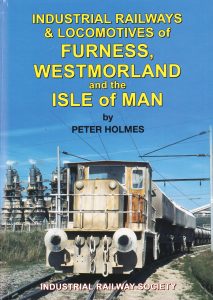
the industrial history of Cumbria and the Isle of Man (his previous book on industrial railways covered Cumberland). It is very well illustrated , with Cumbria Archives and Local Studies Centre in Barrow clearly having helped considerably, as well as many private and other institutional collections.
The book should be read by anyone interested in the wider history of Cumbria, as well as industrial railway enthusiasts. A reference copy ifs available at Kents Bank Station Library, kindly donated by the author. Published by the Industrial Railway Society price £39
Slow Trains Around Spain Tom Chesshyre
Tom’s new book is subtitled ‘a 3000 mile adventure on 52 Rides’. I’ve only flicked through it and I want to take my time with this fascinating but clearly very readable book which combines railways with culture, politics and a strong ‘sense of place’. So perhaps more on this in the next Salvo! Published by Summerdale £9.99.
Fields of Marks – the life and work of Milan Ivaniĉ Roz Ivaniĉ
This is a remarkable book which deserves wide promotion. Milan, Roz’s husband, is a brilliant artist and this book, a labour of love in many ways, is a great tribute to his work. Milan was born in 1947 in Rakovec, Slovakia – just north of the Danube. His father was a railway worker and was conscripted into the German army during the Nazi occupation – and ended up in the ‘railway corps’ in Russia. After the war ended he made his way home and became a track worker for CSD (Czech State Railways). 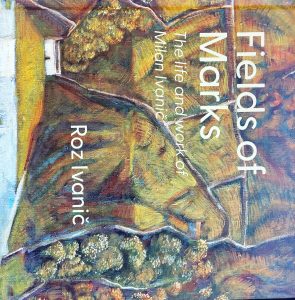
The book is more than a collection of Milan’s paintings – though that in itself would be more than worthwhile. It tellsthe story of Milan’s life and also his relationship with Roz. Milan became a committed communist, at a time when politics in Czecholsolvakia were changing radically, with Dubcek’s ‘socialism with a human face’ in the mid-60s, leading up the Russian invasion of 1968. Milan left for the UK in 1978 and has lived in Lancaster where he is part of the thriving art scene there.What to say of his work? It’s remarkably diverse, many different styles and subjects. It deserves wide recognition. Published privately by Roz, price £34. Copies are available at Kents Bank Station Library
Books in print (at gradely prices)
Northern Rail Heritage: an introduction to the social history of railways in the North of England is available price £5 from Kents Bank Station Library, cheques for £8 (including post and packing) to Kents Bank Library, c/o Station House, Kentsford Road, Grange-over-Sands LA11 7BB. ISBN 978-1-0683741-0-4
The Loco Vanishes – Northern Rail Mysteries available price £13 (including post and packing) from Kents Bank Station Library (address above). ISBN 978-1-0683741-1-1. See above for more…
Lancastrians: Mills, Mines and Minarets I still get invitations to speak on my book on Lancashire’s history. The book is hardback, price £25. Salvo readers can get it post free directly from me: http://lancashireloominary.co.uk/index.html/order-form Or from publisher Hurst. Get in touch if you’d like a talk about the book and its themes. Later this year I’m talking to Bolton Soroptimists on ‘Great Lancashire Women Whom The History Books Ignore’.
ALLEN CLARKE: Lancashire’s Romantic Radical £5.99 (normally £18.99): the only biography of Allen Clarke/Teddy Ashton (1863 – 1935): Lancashire dialect writer, socialist, cyclist, philosopher, poet, novelist…and more. Born in Bolton, mum and dad were millworkers; spent his later years in Blackpool. A remarkable chap who helped keep memories of the 1896 Winter Hill Trespass alive, friend of Tolstoy, admirer of Walt Whitman, etc. etc.
The Settle-Carlisle Railway A history of the famous route with an emphasis on the human story (including my own, as a guard in the 70s!). £14 including p and p.
Last Train from Blackstock Junction (published by Platform 5 Books). A collection of short stories about railway life in the North of England. Salvo readers can get the book at a specially discounted price, courtesy of Platform 5 Publishing. Go to https://www.platform5.com/Catalogue/New-Titles. Enter LAST22 in the promotional code box at the basket and this will reduce the unit price from £12.95 to £10.95. I’ve a few copies of my own to sell at £10.95 plus p and p.
With Walt Whitman in Bolton: This has been out of print for a few months but I’m doing a new edition, with at least one additional chapter. Likely to be out for next May.

One reply on “Northern Salvo 329”
Best wishes to all for the Season. 100% agree with your editorial, Paul, and ideas for the future of GBR. I found Tom’s book a good read – and some interesting points of personal detail to me (not specifically mentioned is what I assume still exists, namely the line on past Benidorm to Dénia – an absolutely stunning journey)