The Northern Salvo
Incorporating Weekly Notices, Sectional Appendices, and Northern Weekly Salvo Published at Station House, Kents Bank, Lancashire-North-of-the-Sands, LA11 7BB
email: paul.salveson@myphone.coop
No. 330 October/November 2026
Salveson’s half-nakedly political digest of railways, tripe and secessionist nonsense from Up North
Long time no Salvo
Greetings from the shores of Morecambe Bay, here at Kents Bank. I’m sorry there has been such a long gap in The Salvo – thanks to everyone who has
asked ‘what’s up lad?’ It has been a combination of the stresses of moving house, some (relatively mild) illness, and having a lot to do with the Library, Rocket All Aboard and other stuff. Hopefully I’ll get back into a routine and do at least a quarterly production. I hope you enjoy this edition – I was thinking about changing the format but people generally seem happy with it – but any suggestions welcome.
The North Resurgent? Andy as PM
Labour really needed a refresh and flippin’ ‘eck we’ve got it. Andy Burnham, through some very deft maneuvering, got himself elected as MP, Leader of the Labour Party and then Prime Minister. He had a rapturous reception at Party Conference in Liverpool and made long-awaited noises about electoral reform. It was a good speech but I’m increasingly wary of highly emotional speeches met by audiences jumping to their feet and applauding. I can’t say as I was hugely impressed by this dragging his late father into the speech to support retaining a centralised UK. Big shifts in people’s awareness are underway and the recent joint statement by the leaders of Scotland, Wales and Northern Ireland presage some major political changes. An intelligent British politician would be looking at ways to refashion the political shape of the British Isles, not use emotional appeals to justify the status quo. As even Trump said, Irish unification will happen eventually so it might as well happen now! Burnham may like to be called ‘King of the North’ but I don’t think he has much of a grasp of the world outside Manchester (and London). But still, give the lad chance.
His big message, apart from cutting my pension, is ‘Devolution’. I’ve written a longer piece on this, see elsewhere in this Salvo.
Kents Bank Station Library
The deadline for the national Community Rail Awards closed on September 30th and we managed to get three entries submitted. Fingers crossed for shortlisting. The event is on March 4th at the Royal Armouries, Leeds.
We continue to receive many generous donations. The most recent was
via Mrs Brenda Wildish, whose late husband had a huge collection of overseas railway publications as well as some fascinating photos. The collection was rescued from a shipping container at Ribble Steam Railway. Thank you, Brenda! Thanks also to Ribble Steam Railway and Furness Railway Trust for acting as intermediaries.
Our MIC (Mutual Improvement Class) talks resumed in September with a well-attended talk on ‘North West Steam in the 60s’ – we’ve got a full programme planned for the rest of the year, on the second Wednesday of each month at 14.00 (see ‘What’s On’). We’re planning another group trip in early October over the Settle-Carlisle Line, with a route commentary by a Friends of the Settle-Carlisle Line volunteer.
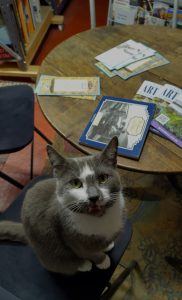
It’s a railway truism that every station should have its own cat – well-known examples include Felix at Huddersfield, which has had a book written about him. Kents Bank isn’t to be outdone by our Yorkshire cousins and we now have our very own station cat – Harry. Harry 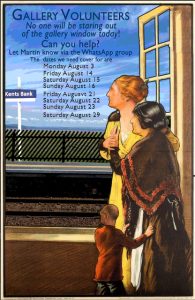 (Stevens) was also the name of one of our well-loved station masters, in the early 1900s.
The pop-up Station Buffet has had a make-over with more space for visitors enjoying complimentary teas and coffee, and the outside Railway Tea Garden has proved popular on warm days.
A determined group of modellers are working on a 009 gauge (narrow gauge N) model of an iron ore mine at Lindal, once the centre of the UK iron mining industry (see below, re Slunk Club). The most recent acquisition is a Fletcher Jennings loco and corrugated iron loco shed!
We are open every Friday, Saturday and Sunday from 11.00 to 16.00 as well as bank holiday Mondays.
For more details of our activities see www.stationlibrary.org.uk or ring 07795 008691. We welcome new volunteers.
WHAT’S ON AT THE STATION LIBRARY
Wednesday October 14th at 14.00 Kents Bank Station Library: The Irish Narrow-Gauge: Yesterday and Today: an illustrated talk on what remains of Ireland’s once-extensive narrow-gauge railways, and some recollections of their final days in the 1950s and 60s. As space is limited please book in advance on 07795 008691.
Wednesday November 11th: at 14.00: Monthly MIC, subject to confirmation, Karen Hornby on ‘Managing Manchester Piccadilly’.
Mid-December tbcf: Book launch ‘The Northern Esoterica Society’ with accomplished Estonian author Tiina Sepp. Hosted by the Westmorland, Lancashire (North of the Sands) and parts of Cumberland branch of the Northern Esoterica Society. Kents Bank features in the quirky and entertaining tales of Northern eccentricity. As space is limited please book in advance on 07795 008691.
SEEK AND YE SHALL FIND
The Library is trying to fill a few gaps in its magazine collection. We are particularly interested in bound volumes of Railway Magazine, vols. 34 and 36 (half years 1914 and 1915). We’re also keen to get more pre-
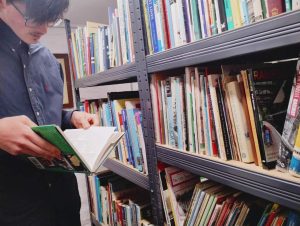
war union magazines – ASLEF, NUR and TSSA (Railway Clerks Assoc. as was). Also bound volumes of railway company staff magazines. Good quality railway books always welcome, if we already have them we sell them on to raise funds. Contact Paul at info@stationlibrary.org.uk
JOIN THE SLUNK CLUB!
Reading Alen McFadzean’s fascinating book on iron mining around Lindal (The Iron Moor, Red Earth Publications 1989), I came across a fascinating reference to the subversive ‘Slunk Club’. It existed in the 1880s, in the Lindal and Dalton area and was supported by local miners. Mc Fadzean describes it as “rebellious by nature, anarchistic in ideals, the Slunk Club’s primary function was to ensure its members availed themselves of a week’s holiday at Whitsuntide. Once in possession of the full entitlement, the membership gathered to parade…and drink.” Part of their activities featured ridiculing the local establishment – including the mine owners, Church of England, Freemasons and Salvation Army.
Their parades were colourful affairs. A report of the trial of some of their members appeared in The Ulverston Mirror of June 1882. Three ‘Slunks’ were charged with being drunk, at Dalton. The report described the scene:
“The officer said they were parading the street at Dalton with an old banjo and Thexton and Dixon (two of the accused) were carrying sweeping brushes or mops on their shoulders…another constable corroborated and said one of the company carried an old thorn bush. Another had a flag and two others had a concertina and a banjo.” Superintendent Whiteside added “the music was not harmonious but discordant, and the defendants were making themselves as ridiculous as possible.”
The club was divided into ‘lodges’ , aping the freemasons. Marton Lodge, a mining community on the outskirts of Dalton, was the head lodge. The press report said that “Each year every lodge presents a belt to the biggest slunk for losing more days of labour in the year.”
It would be interesting to find out more of this subversive organization. Does it still exist? Should it be revived?
ROCKET ALL ABOARD RAA RAA RAA
Rocket All Aboard (RAA) is planning the celebrations of the Liverpool and Manchester Railway’s 200th anniversary in 2029/30. We have put in for a substantial grant to National Heritage Lottery Fund and we hope to hear if we’ve been successful in early December. We are also looking t
o a sizeable Arts Council England bid. This is on top of funding we have already received from local authorities and the rail industry.
To mark the 200th anniversary of the start of work on the line (September 1826) there was a magnificent concert at the Tung Auditorium, Liverpool, celebrating The Dawn of the Railway. Heswall Concert Band performed Extraordinary Machines of Clockwork and Steam by Scott Watson and The Great Locomotive Chase by Robert W. Smith. Highlight of the evening was the premiere of Dawn of the Iron Road 1826 by young local composer Matt Holroyd.
A brilliant evening, complemented with poetry and talks. Acclaimed American composer Steve Reich is doing a Rocket-linked concert in Liverpool in October, featuring his brilliant piece Different Trains. A reception is being held at Edge Hill station before the concert.
We recently had some very positive discussions with Alstom (who hosted the Greatest Gathering) and the Heritage Railway Association. RAA has a very open and inclusive approach, which includes a six-monthly gathering of everyone who has expressed interest in the project. Our next get together is in Liverpool on November 12th. If you’re interested, or just want to be on the mailing list for information, contact RAA’s website: www.rocketallaboard.co.uk
Devolutionary Times?
A centrepiece of Burnham’s vision is his commitment to ‘devolution’. Within hours of being made Prime Minister he announced that there would be a ‘Number 10 North’, located in Manchester. It’s already doing business and senior civil servants are busy making the move north.
This is all good stuff, but how radical is it? The ‘devolution’ which Burnham espouses isn’t all that, well, devolutionary. Dispersing government departments around the country isn’t new, though having a Prime Ministerial base outside London is, and there’s nowt wrong with that. But it’s not devolution of power. We will still have a centralised legislature, with some civil servants working partly up North and partly down South. Which will be good for Avanti West Coast and will also help influence civil servants’ view of the world in which they live. I’ve always been a fan of Marx’s dictum, that ‘material
being determines consciousness’, or something like that. Where you live determines how you think, in other words. From my experience I’ve found senior civil servants a) generally very nice people, b) highly intelligent and c) in a mental universe that is highly London-centric. Having them living outside London, even in Didsbury or Chorlton, might help how they view the world. Even better if they moved to somewhere like Farnworth (the beer’s cheap), Radcliffe (good tram service) or Hindley (nice station gardens). All three have large, mainly empty, town halls reflected the destruction of local government in the 70s. But wherever it is located, the civil servants in No. 10 North will still be responsible for implementing policy determined by Westminster, rather than the regions and nations of the UK. Even if the House of Commons was moved up North while they spend a fortune on renovating it (Dewsbury Town Hall would be perfect), this would still be a highly centralised government.
Yes you might say, but Andy has championed the setting up of city-region mayors, with the creation of new ‘mayoral strategic authorities’, while reforming local government and creating new unitary authorities. But this is where it starts to get a bit messy. Local government in England is rapidly disappearing, being replaced by large unitary authorities which are anything but ‘local’. I live in ‘Westmorland and Furness’, a relatively new ‘local’ authority which stretches from Morecambe Bay to just south of the Scottish border, taking in large centres such as Barrow and Kendal and dozens of smaller market towns and villages. It is neither ‘local’ nor ‘strategic’. Next year we’ll get an elected mayor for the new strategic authority of Cumbria, but he or she will not be scrutinised by an elected body. The same has applied
to the well-established mayors of Greater Manchester, Liverpool, West and South Yorkshire and so on. Generally, they’ve done a creditable job but there is a big democratic deficit here, about which most politicians and commentators are silent.
Meanwhile, slightly further south, the county authority of Lancashire was going to be split into four, with the abolition of local authorities such as Preston, Blackburn with Darwen, Blackpool and Burnley. Instead it looked like there would be four unitary authorities, imaginatively termed North, South, East and West Lancashire.
In a surprise move the changes have been put on hold. Good – they should be scrapped. Local government would become even more remote from the communities they supposedly represent, with historic identities trashed. The result would be even less interest in local politics.
Sadly this was being done by a Labour Government, but one of Labour’s traditional blindspots has been a combination of a highly centralist mode of thinking combined with, in many cases, a contempt for local identities and traditions which the smaller local councils exemplified. It all went badly wrong in 1974 when small and usually very efficient local councils were scrapped, replaced by larger ‘metropolitan’ authorities.
If Burnham is serious about devolution, he needs to go back to Blair and Prescott’s plans for regional government in England. Wales, Scotland and Northern Ireland have elected (by PR) assemblies which form an obvious model for England – combined with smaller local councils which reflect real identities, working with genuinely strategic regional assemblies with more powers devolved from London. Come back The Hannah Mitchell Foundation, we need you to make the case!
(First Published in Chartist October 2026, slightly amended)
Over the sea to Ireland: a record of a memorable trip
Four of us went on the trip – Michael (a healthy 90-something), Tim, Brenda and myself. Given the complexity of the journey, car was the only option. We set off from Kendal taking the A6 via Shap and M6 to Gretna, and then A75 to Cairnryan Ferry Terminal.
Along the Antrim Coast and Glens
We arrived at Larne on time and we took the magnificent Coast Road to Carnlough, to check into our accommodation in The Harbour View, which credits itself as Ireland’s ‘first whisky hotel’. We decided to stick to Guinness, which was excellent. It was a drizzly evening but we
decided to explore some local railway remains. The Coast Road passes through the ‘White Arch’ which carried an iron ore tramway down to the coast. The narrow-gauge Ballymena, Cushendall and Red Bay Railway was built to serve local mines and ended on the side of a hill. It served Ireland’s highest station – Parkmore. Apparently the original station building survives but is completely enshrouded by trees. The railway reached neither Cushendall nor Red Bay, ending, appropriately, at Retreat where a building survives, high up on the mountain-side.
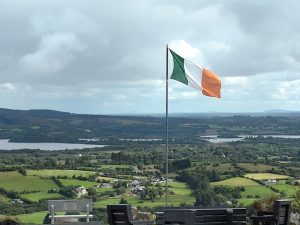
I had time to explore round the village, which has a delightful harbour. It was once served by a tramway which brought iron ore down from the hills – the castellated bridge which carried it over the main street remains as a footpath. The villages and small towns along the Antrim coast each have their own character – some very Loyalist, others equally strongly Republican. Some a mixture. I got the impression that Carnlough was quite mixed, though the Irish tricolour was flying proudly over the harbour. I had a look round the fine modernist Catholic church of St John’s before we set off up the coast, stopping at Cushendall. This small town is mainly Republican/Nationalist/Catholic in its allegiance. There was a memorial to the hunger strikers on a wall down a side street. Everyone was very friendly and welcoming. We called in at the superb Tourist Information Hub which has a great bookshop.
The Ballycastle Railway and ‘Jeep’ memories
We headed off northwards through Cushendun and Ballycastle, striking inland to see what we could of the Ballycastle Railway. This was another 3’ gauge line which carried passengers as well as goods down to the main line at Ballymoney. A tunnel at Capecastle survives. From there we made towards Bushmills and the Giant’s Causeway. The area is hugely over-developed and was choked with traffic. We had a look at
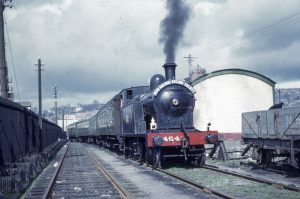
the shortened tramway which runs from Bushmills to Giant’s Causeway but decided to escape as quickly as possible. We headed north for a coffee stop at Portstewart, an interesting old-fashioned resort which adjoins Portrush. I have happy memories of riding behind the 2-6-4T ‘Jeeps’ on Sunday School specials to Portrush in the late 60s.
Ferry to Inishowen and old railway remains
Instead of aiming for Derry we turned off towards Magilligan Point, where the Foyle enters the Irish Sea. We boarded the ferry across to Greencastle, arriving in Donegal, part of the Irish Republic. I’d never been to Donegal so this was very exciting. We were now on Inishowen, a large peninsula which once had quite a bit of railway. The line to Carndonagh closed in 1935 but the station building survives as a business centre. A feature of many of the narrow-gauge lines was how well the buildings were constructed and how many have survived. A real delight was Drumfries where we stopped off at ‘The North Pole’ bar in what was the station house. Again, a friendly welcome and we were pleased to see many photographs of the station and the line on display. We had hoped to get to see something of Derry City and in particular the railway museum but it was not clear whether it was operating.
In Wild Donegal
The following morning the weather wasn’t good so we decided against walking round Derry. Instead we used the extra time to see what remained of the Londonderry and Lough Swilly Railway’s Burtonport Extension, which closed in 1940 and to Gweedore in 1947. This ran through real ‘Wild Donegal’ country and we had a superb drive. The rain was interspersed with sunshine which is exactly how I imagined Donegal (partly from drooling over Julie Christie in The Railway Station Man).
One of the highlights of the whole trip was coming across the remains
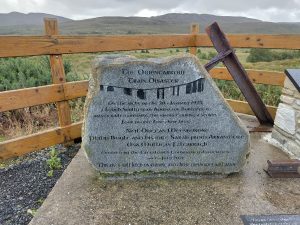
of Ownencarrow Viaduct and the memorials to the four passengers who lost their lives when a freak gust of wind blew a carriage off the viaduct, on January 30th 1925. The piers survive, in what is a truly dramatic location. The Burtonport extension closed in 1940 but it is still possible to see traces of the route.
A really big treat was calling in at Cashelnagore, situated in about as wild and remote a place as you’ll find in these islands. The station starred in The Railway Station Man, together with Julie Christie and Donald Sutherland. Sutherland gives one of the best descriptions of
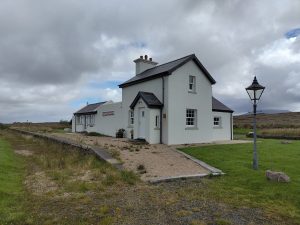
traditional signalling practice on single-line railways as you’ll get anywhere. And Julie Christie plays a good part too. Sadly neither were there to greet us and the station looked a bit shabby and possibly unoccupied. The weather was suitably wild and blustery.
A bit of the old ‘County Donegral’
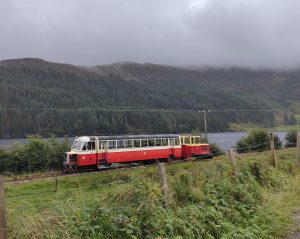
We headed south to reach Fintown, on the Co. Donegal Joint Railway which once operated a network of over 125 miles, all 3’gauge. Fintown is the base of the Co. Donegal Railway heritage group which operates about two miles of line alongside Loch Finn. It was on the line from Stranorlar to Glenties. They operate one of the original CDR railcars and once again we had a really friendly welcome. The CDR closed completely early in 1960.
Glenties was our next stop, just in time to visit the excellent local history museum before it closed. They kindly stayed open so we could have a good look round and inspect the 2’ gauge petrol loco which used to operate on a nearby peat railway. We were booked in at The Nesbitt Arms in Ardara, a town which the railway never reached (there was an ‘Ardara Road’ on the Co. Donegal, a long way from Ardara though). We called in for a pint of Guinness in Nancy’s and had high hopes for one of their famous pizzas. Sadly there was a two hour waiting list so we returned, pizza-less, to the hotel and had an enjoyable meal. We enjoyed some great Irish music in the Corner House pub next door. The passenger station at Glenties survives even though passenger services ceased in 1947.
A sunny morning! We travelled from Ardara towards Killybegs and
then across to Donegal Town. The original station building is now the home of the Donegal Railway Museum, which is excellent. They have one of the original CDR locos on display and much more on the history of the Co. Donegal. We had time to have a look round the town which is impressive.
Haircut in Enniskillen: the amazing HeadHunters
We continued, more or less along the border between the Republic and Northern Ireland, to reach Enniskillen, in Co. Fermanagh. This is a bustling town, hardly possible to imagine the tragic loss of life when the ‘Real IRA’ exploded a bomb during the Remembrance Day parade.
We had a very definite mission – to visit the local barber’s shop, HeadHunters. Not because any of us really needed to be shorn but because HeadHunters is also a wonderful railway museum and gallery. Michael was a well-known visitor and treated himself to a haircut by Nigel, while we marvelled at the amazing collection of railway memorabilia all around us.
The Cavan and Leitrim
We continued our travels to reach Bawnboy, which was to be our base for the nest three days. We were met by our host Nigel whose family have long connections with the Cavan and Leitrim Railway. His grandfather was a director and his grand-daughter, Isabel, had a locomotive named after her. Nigel was a most considerate host, going out of his way to be helpful and hospitable.
The following day we visited Mohill, a very special place. We were met by Mary at the Station House, on the route of the Cavan and Leitrim. This was quite a substantial building which had fallen into dereliction many years ago. Thanks to a determined effort, and 500,000 Euros worth of funding, the building has been transformed – and only very recently. The first guests in the Air BnB section arrived in June. Some nice ex-pat Americans were staying when we visited.
We were introduced to several people who had played a big part in the station’s restoration, including Maeve and Karen from Leitrim County Council, other community volunteers (whose names I missed), Sean Browne who runs the railway-themed pub in Castlerea and Michael Kennedy from the C&L Museum at Dromod. We chatted with Cyril, a skilled local engineer who is constructing a full-size replica of a C&L locomotive which will have pride of place outside the station. We were treated to a most delightful piece of singing Fionnuala Maxwell. a local
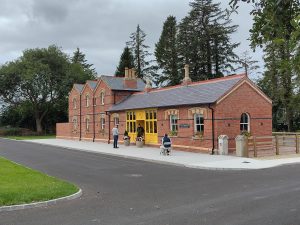
exponent of Irish music and all-Ireland award winner. Mohill has very special connections to Irish culture being the home for many years of the famous harpist Turlough O’Carolan, whose statue stands in the town centre.
Note: The comfortable two bedroomed Station Master’s cottage at Mohill can be booked on air bnb or directly by email to hello@mohillstationhouse.com.
The Cavan and Leitrim Railway (3’) comprised two lines. The main route was from Dromod via Mohill and Ballinamore to Belturbet. The branch tramway left Ballinamore to serve the coal mines at Arigna. Although only a tramway it formed the railway’s bread and butter, bringing coal out to be trans-shipped at Dromod or Belturbet. The whole lot closed in 1959, with a young Michael Davies amongst the mourners. We visited the coal mining museum at Arigna, at the top of a steep hill from where the coal was dug. It was a great museum with a very nice cafe, enjoying fabulous views over the surrounding countryside. The museum curators have done a great job in highlighting the contribution of the miners themselves with some superb photos of life down the pit. There was quite a lot to see of the remains of the Arigna tramway, including a water tower and station house at Drumshanbo.
Our last call of the day was at Ballinamore, once the hub of the Cavan and Leitrim Railway with a large station, engine shed and workshop. The station building and workshops have survived, the latter being home to Leitrim School of Art. We were invited in (the place was actually closed for the day) and treated to coffee and cakes and a talk about the work of the school, which is soon to open as a public gallery. A good use for a railway building!
This was our last full day so we were determined to pack a lot in. We had been invited back to Mohill Station House to be interviewed by Shannonside Radio. Their main interest was Michael’s story, having travelled on the last train on the Cavan and Leitrim in 1959, We were treated to more of the volunteers’ delicious fruit cake before continuing to Dromod, home of the present day C&L.
Volunteers, led by Michael Kennedy, have done a brilliant job in bringing the railway back to life with a huge range of equipment on
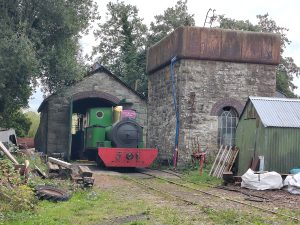
view. The star was ‘Nancy’ who was being steamed the following day. We had a little petrol-engine loco take us the 800 yards down the line to Clooncolry Level Crossing where the route has been severed by a road. The original narrow-gauge station , including the surviving station house, is alongside the broad-gauge main line from Dublin to Sligo, so perfect rail connections!
It was a special couple of days for the railway, as it was Heritage Weekend. The railway was operating regular services and visitors were given an informative talk by volunteers about the railway and its exhibits, which ranged from locomotives to buses, field guns and aeroplanes. Star attraction was the rail-cycle which had been rescued from scrap and rebuilt.
From Dromod we headed west to Carrick-on-Shannon, the county town of Leitrim and a place with a real buzz to it – nice cafes, pubs and several bookshops. As with so many places, we came away wishing we had more time to explore.
Glenview Folk Museum and Johnny Gaffney
We continued towards Ballinamore to Glenview Folk Museum. This is the work of Brian Kennedy and his son Alan, who have collected an incredible range of exhibits. There was much about local cultural, economic and political life in this staunchly Republican area. It was interesting to see some paperwork from loco drivers’ union ASLEF advertising Johnny Gaffney’s candidate as a staff representative. Gaffney was a driver at Ballinamore and I’m currently doing more research on his remarkable life.
We returned to Ballinamore and a very enjoyable meal at Smyths, whose landlord Ciaran knew Michael from previous visits. The meal of the day – Stew – was delicious. Another good friend of Michael’s, Séan Ó Súilleabháin, called in for a pint and a chat on his way to the football match.
However, we were able to get glimpses of the Clogher Valley Railway as well as some of the long-closed broad-gauge lines. The rail network in the west of Ulster was destroyed by a fanatically pro-roads Stormont Government, with closures reaching their peak in 1965. Substantial towns such as Enniskillen, Strabane, Omagh and Dungannon lost all of their railways.
Heading for home
We went via Dungannon and Toome Bridge and reached Larne by 12.45. We reflected on the folly of closing the Derry Road from Portadown (and south from Dublin) to west Ulster , Strabane and Derry. But good to see its re-opening is on the agenda. We came back from Larne on the P&O sister ship European Highlander and had another punctual, and very smooth, sailing.
My thanks to everyone who made our visit such a delight – Nigel, Mary at Mohill, Michael at Dromod and many others, including Tim and Brenda who did the driving and Michael who entertained us with his tales of travelling on the Irish narrow-gauge in the 50s. It was good to see Ireland re-discovering both its railway heritage but also the future potential of rail. How I would love to travel on a re-opened Derry Road before I get sent to the Great Scrapyard.
BOOKS OF NOTE
Hopefully the next Salvo will have more books reviewed but space limits us this time. Here are two very special ones.
The Northern Esoterica Society by Tiina Sepp
This is a fascinating book – and I’m not saying that just because Kents Bank features! (Esoteric, or eccentric?) The author is a folklorist and anthropologist and lives between Estonia (her home country) and England.It brings an informed insight into the likes of railway enthusiasts, canal types, Routemaster buses and their followers, old churches and lots more of what is often termed ‘quintessentially English’ things. I’d say that being from foreign parts (Estonia) strengthens her insights, perhaps seeing beyond what we might regard as commonplace.
Further on the society in due course but we’re hoping to do a launch soon here at Kents Bank, and have copies for sale. To get yours directly contact Tiina on peregrinatina@gmail.com ISBN 978-9908-9852-0-6
Depositions by Anton Floyd
A most remarkable collection of poems by Irish writer (and exile) Anton Floyd. The foreword, by Aoife Harte of UNHCR Ireland, says:
“Poetry is a unique form of art which allows us all to process human experiences in an attempt to understand the changing world around us. More than 110 million people have been forced to flee war, conflicts and persecution from Ukraine, Afghanistan, Yemen and other parts of the world. This number continues to grow.”
This is the context for Anton Floyd’s poetry in Depositions. It is an unusual book. This edition is published in five languages: Irish, Welsh, Scots Gaelic, Lallans Scots and English. Depositions has also been translated into other fifteen other languages.
“At the heart of Anton Floyd’s new collection, at its very throbbing core, are the assembled witnesses of history, proclaiming themselves in the form of haiku-liketercets. The three line poem is the last placard available to the poet in the sinking or on the burning barricade. These poems contain the winds that blow each refugee into exile, allow the dust of a lost paradiseto lodge beneath the fingernails, preserve the fumes of war in ragged clothing and reveal entire families washed up on the shoreline.” – Thomas McCarthy
At a time when refugees are being vilified and attacked, Depositions is a reminder of why the vast majority of refugees attempt to flee their own native lands. Look out for details of book launch at Kents Bank next month. Hopefully one to follow in Bolton.
Books in print (at gradely prices)
Northern Rail Heritage: an introduction to the social history of railways in the North of England is available price £5 from Kents Bank Station Library, cheques for £8 (including post and packing) to Kents Bank Station Library, c/o Station House, Kentsford Road, Grange-over-Sands LA11 7BB. ISBN 978-1-0683741-0-4
The Loco Vanishes – Northern Rail Mysteries available price £13 (including post and packing) from Kents Bank Station Library (address above). ISBN 978-1-0683741-1-1
Lancastrians: Mills, Mines and Minarets I still get invitations to speak on my book on Lancashire’s history. The book is hardback, price £25 from publisher Hurst. Get in touch if you’d like a talk about the book and its themes.
ALLEN CLARKE: Lancashire’s Romantic Radical £5.99 (normally £18.99): the only biography of Allen Clarke/Teddy Ashton (1863 – 1935): Lancashire dialect writer, socialist, cyclist, philosopher, poet, novelist…and more. Born in Bolton, mum and dad were millworkers; spent his later years in Blackpool. A remarkable chap who helped keep memories of the 1896 Winter Hill Trespass alive, friend of Tolstoy, admirer of Walt Whitman, etc. etc.
The Settle-Carlisle Railway A history of the famous route with an emphasis on the human story (including my own, as a guard in the 70s!). £14 including p and p.
Last Train from Blackstock Junction (published by Platform 5 Books). A collection of short stories about railway life in the North of England. Salvo readers can get the book at a specially discounted price, courtesy of Platform 5 Publishing. Go to https://www.platform5.com/Catalogue/New-Titles. Enter LAST22 in the promotional code box at the basket and this will reduce the unit price from £12.95 to £10.95. I’ve a few copies of my own to sell at £10.95 plus p and p.
With Walt Whitman in Bolton: This has been out of print for a few months but I’m doing a new edition, with at least one additional chapter. Likely to be out for next May, hopefully.