The Northern Weekly Salvo
Incorporating Slaithwaite Review of Books, Weekly Notices, Sectional Appendices, Tunnel Gazers’ Gazette etc. Descendant of Teddy Ashton’s Northern Weekly and Th’Bowtun Loominary un Tum Fowt Telegraph
Published at 109 Harpers Lane Bolton BL1 6HU email: paul.salveson@myphone.coop
Publications website: www.lancashireloominary.co.uk
No. 305 July 11th 2022
Salveson’s half-nakedly political digest of railways, tripe and secessionist nonsense from Up North. Sometimes weekly, usually not; definitely Northern.
General gossips
Twenty-one days is a long time in politics (when the last Salvo was issued).Way back then, the position of Boris Johnson seemed relatively secure. Things change so quickly, don’t they? The next few weeks should offer plenty of summer entertainment, taking our minds off things like Ukraine, rail strikes and rocketing energy prices. When people ask me whom I’d like as leader, it’s difficult. I want them to lose in a General Election, so my top choice would be for Johnson to stay on.
That’s not going to happen now, sadly, so maybe some complete fruitcake like Nadine Dorries would do the job? Grant Shapps could be a possibility too. Maybe this is a selfish view and not really the best for the country. On the other hand, putting myself in the hard-to-imagine position of being a Conservative supporter who actually wants them to win, Sunak is the obvious choice.
Meanwhile, Labour will lumber on with a less-than-inspiring leader who struggles to find policies which differentiate them from the Tories, and in some cases are even more reactionary (e.g. saying he would actively campaign against Irish unification, which is a clear breach of the Good Friday agreement). ‘He said he’d make Brexit work’ could be the words etched onto his political tombstone after the 2024 General Election, perhaps with a slimmer Tory majority and Rishi Sunak as Prime Minister. Still, these things can change very quickly, as we have seen.
Durham Constabulary has done its bit to ensure that Labour will remain an uninspiring bunch. Speaking of the police, have you been watching ‘Sherwood’? It was very well done, though I found the short-sighted single-manned train driver (who got his facts wrong about the Settle-Carlisle line) a bit weird.
Goodbye to ‘Ye Olde Booking Office’? corner-shop economics applied to rail
My last Salvo about the rail strikes got a muted response from readers, with most who responded saying they generally agreed with me. In summary, nobody begrudges rail workers a decent wage, but bringing the rail network to a standstill at a time when the recovery is fragile to say the least, might not be a good idea. We could end up with a smaller railway employing much fewer railway staff.
One of the worrying messages coming from rail industry leaders is that the days of the staffed ‘booking office’ are numbered. OK, on one level it needs to change. Even the archaic name ‘booking office’ reeks of Victorian ways of running a railway. Let’s look at the issues.
Firstly, there is no doubt that more and more rail passengers are buying tickets on line. This is in the face of persistent advice from me (mainly to my daughters) who think, usually wrongly, that they get a better deal ‘going on line’. That trend will continue. What we offer ‘customers’ at staffed stations is often a less-than-ideal experience, having to communicate with someone stuck behind a window who can present, without intention, the image of unfriendly officialdom. It’s a system that even banks have done away with. I think for many journeys
involving different options with the kind of ticket purchased, being able to talk to a real live person sat alongside or in front of you is important. For larger stations, we need to keep a decent number of highly trained and well-motivated staff, with good language and inter-personal skills.
But what of the small station which might have a footfall of around 200,000 passengers a year and may offer nothing more than a single person doing say a 6-2 shift? Many stations around the North fall into that category, and the staff may only be dealing with passengers using a couple of trains an hour, or less. ‘Close them,’ the unimaginative rail manager will say. But there are other ways. Think about it, how barmy is it that someone is sat there in a ‘booking office’ selling only one product (i.e. rail tickets). Can you imagine a petrol station selling nothing other than petrol?
Merseyrail piloted an interesting scheme some years ago called ‘M to Go’, with their partner Merseytravel. This involved some ‘booking offices’ being transformed into convenience stores. Rail staff would sell train tickets but also a range of other products. As far as I’ve heard, the scheme has worked though it is very location specific (like any other retail business).
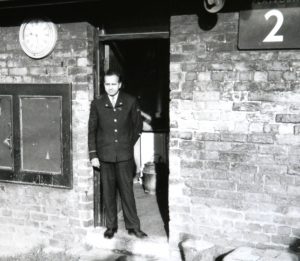
It seems a very sensible alternative to closing a booking office, leaving smaller stations unstaffed and more threatening places to use the train.
In some areas, bodies such as Transport for Greater Manchester or West Midlands Rail Executive could take over the running of smaller stations and develop them along the ‘M to Go’ lines. I suspect the train company, who currently is responsible for the staffing and operation of these smaller stations, would be glad to see them go. Having a large body like TfGM or WMRE taking over responsibility for smaller stations would ensure economies of scale in procuring materials (the usual convenience store items) as well as ensuring high customer care standards and staff training. Potentially, again depending on location, there may be scope for extended opening hours and more staff, including use of part-timers.
There is a ‘community rail’ angle to this as well. One or two stations (e.g. Gobowen) have staffed booking offices run by a social enterprise. That could work in several locations, including stations outside the larger combinations without the benefit of a regional transport body like TfGM but possibly with an active community rail partnership. There are quite a few stations that could develop this way, with the support of an active CRP or ‘station partnership’. It would be wrong to set hares racing by mentioning particular stations but many readers would know the sort of place I mean. In some cases there may be scope for bringing a currently unstaffed station back to life. In other cases, as an alternative to de-staffing a station and losing an important community asset, hand it over to the community.
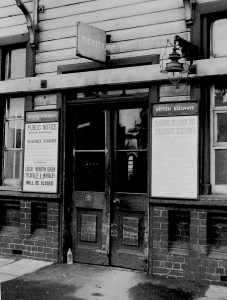
If there are enthusiastic station staff at a small ‘at risk’ station, offer it to them with first refusal, with a clear contract on what would be expected and a favourable rent, but outside of mainstream regulation. So essentially we’re talking about several categories of station, viz.,:
Category 1: Large station, staffed by train company, with specialist advisers, including offering one to one travel advice (multi-modal), with other retail available within station.
Category 2: Medium-sized station, possibly with combined retail and ticket sales, staffed either by the train company or a transport body such as TfGM, WMRE, Merseytravel etc. Could also do bike hire etc.
Category 3: Small station, staffed by employed agents providing a mix of rail tickets and ‘convenience store’ goods. In tourist areas scope for doing a range of tourism-related products and sales.
Category 4: ‘Community Station’ run independently by a social enterprise, small business or similar, offering perhaps a limited range of rail tickets and advice, plus ‘local shop’ functions and other goods depending on location. Local post office?
Category 4 is about applying ‘corner-shop economics’ to a small station. If anyone has a better idea for how they might survive without being a drain on the railway, let me know.
Another World Should Be Possible
Geoff Mulgan is one of the most interesting political writers around today, writing fom a left-of-centre position. His work is relevant to anyone with a political brain who isn’t stuck in old certainties of right and left. His latest book, Another World is Possible – How to Reignite Social and Political Imagination – couldn’t be more timely, for reasons I hardly need to stress. The argument is really quite simple. For whatever reason/s we have lost the ability to look to the future and imagine a different (obviously, better) world. As Mulgan asks: “how could we become better at imagining the society in which we might like to live a generation or two from now?”
The Conservative Right’s idea of ‘the future’ has always tended to be backward-looking. Leaving Europe has been the latest ‘big idea’, but the idea of a future Britain is very much about going back to how it was, in a world before the EU and – for many – before immigrants. Is the Left any better? 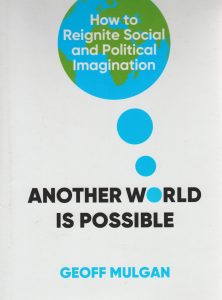 Our ‘golden age’ was the time of post-war Austerity and the Labour Government of Clem Attlee. It was a highly statist politics, which was probably what was needed to recover from the horrors and destruction of the Second World War. Yet there are quite a few who still think that political and economic model is what the country needs today. You can summarise it as ‘Corbynism’. A pity he didn’t listen more to his pal John McDonnell who did have some good, radical, ideas on the economy.
A key part of Mulgan’s argument is that ideas don’t often just ‘pop up’ from nowhere, the brainchild of some great man or woman: “Individuals and teams flourish best in a vibrant milieu that brings together comment and criticism, competition with peers, and the feedback of an informed audience.” (p.132).
Mulgan was a key figure in the ‘New Labour’ experiment under Tony Blair; he headed up the Number 10 Policy Unit so knows a bit about how Government works and how policies are shaped. Incidentally, it’s a reflection on the paucity of political thinking on today’s Left that mentioning Mulgan’s role under the Blair Government would instantly damn him for all eternity.
He is highly critical of contemporary social democracy, with an agenda lacking in the imagination he promotes, limited to modest (and getting more and more modest by the day) policies. “Tepid oppositionism blames everything possible on capitalism or neoliberalism, a comfortable space which requires no serious self-criticism. Timid incrementalism advocates keeping everything as it is but with a few modest tweaks; this is a comfortable space in another sense, in that it requires so little change. Historic defensiveness protects the interests of particular groups – those with influence in the parties – against any changes that could weaken them, for example a group of workers resisting any use of new technology that could educe their numbers.” (p.182)
Keir Starmer, and the Labour Party as a whole, need to read and reflect on what he is saying. The sort of imagination he advocates is light years away from that timid politics based on what London politicians imagine northern working class voters are thinking at any particular moment in time.
There is one small problem I have with the book, the age old challenge (posed by Mao-Tse-Tung I seem to remember) about ‘where correct ideas come from?’, or what are the networks and institutions that can encourage the sort of progressive imaginative thinking he advocates? It’s a particular issue for the North of England, where we have become used to policies being dumped on us by politicians based in Westminster and civil servants in Whitehall. Whilst Scotland and Wales have developed alternative intellectual bases, the North of England (bigger than Scotland and Wales combined, though it isn’t about size) has very little. IPPR North does a good job but its’ influence is limited. The Hannah Mitchell Foundation, which had much potential, is running out of puff. The universities are an obvious source of imaginative thinking but too often a university can be an island of ideas, not connecting with the world around it. Imagine the potential for a progressive local authority linking up with its university and local business and voluntary sector to work out how their town or city could look in twenty years? Or even a group of universities collaborating with regional partners on a shared vision for their region? Mulgan, rightly, isn’t prescriptive on what his ‘competing political imaginaries’ might be, but does toss a few ideas out. But it’s more the process of thinking through a desirable future that he stresses.
Another World is Possible is published by Hurst (2022)
Skirl o’the pipes heard in Leigh
I had planned to join the annual walk to Waugh’s Well, with the Edwin Waugh Dialect Society. It’s allus a gradely do and they had fine sunny weather. Unfortunately, my left foot was far from jannock and I had to send reluctant apologies. I’d been planning to have a trip to Leigh to look at their Local Studies Centre so that seemed a good alternative, not involving much walking. I made a good connection from the 526 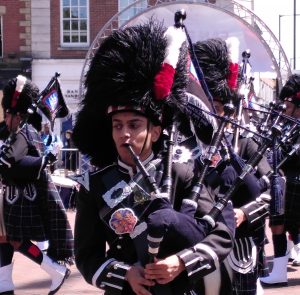 onto the 582 Leigh bus at Bolton Interchange and headed through Atherton and past the superb miners’ cottages at Howe Bridge, built as showpieces by the Fletcher Burrows company. If only all miners’ housing had been built like that. All was going well until we reached the edge of the town centre, with ‘diversion’ signs directing us onto a convoluted route round the back of town. Yes, I know, I should have got off when the diversion started but stayed on, for another 20 minutes as it turned out. The diversion was on account of various festivities taking place around the 2022 European Women’s Football Championship, some matches being played in Leigh (I think England v Portugal). A ‘fan party’ was taking places in the Market Square, hence the diversions (actually, I’m not really sure why they had to close the road, but anyway…).Leigh Archives are located in the town hall which was in the ‘secure area’ where the fan party was taking place, so I dutifully showed the security staff the contents of my bag (flask, cheese sandwich, wagon wheel and note book) and was allowed in. The archives weren’t open because of all the other goings-on but I had a good look round the local history museum, which is excellent. Two of my favourite ‘Leythers’, Tom Burke and Mary Thomason, were prominently featured. You could press a button and hear Tom singing one of his arias, and another to listen to Mary reciting a dialect poem. The effect of pushing both at once, as some children insisted in doing, was slightly odd (it was a day of odd, but enjoyable, things) but nice all the same to hear Tom Burke singing, in Leigh. Part of my quest in going to the Leigh Archives was to look at copies of The Leigh Co-operative Record, which Mary wrote for in the 1920s.
The highly-regarded Turnpike Gallery is in the library building, just 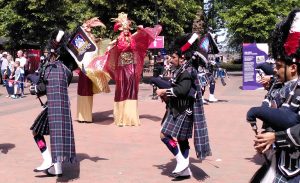 across the square, so I thought I’d pop across and see what was going on, before heading back to Bolton. There was a bit of a commotion going on in the library foyer but I was told I’d be OK to squeeze through the assembled throng. The said throng comprised a large number of young Asian lads dressed in regimental Highland costume, wielding an assortment of pipes and drums. It was the Shree Muktajeevan Swamibapa Pipe Band, all the way from Bolton. They made an impressive sight as they emerged from the Library foyer to perform around the Market Place, and an even more impressive sound. The band uniform includes a black bonnet with white and red feather, black doublet, blue tartan kilt, sporran, and a blue tartan plaid. Some of the members were young lads, clearly enjoying themselves, as were the spectators. The whole scene was made even more surreal (difficult, I know) by the two giant fairies who were swirling around to the music. After the performance was over I had a look at the open-air exhibition on women’s football. It’s not a sport I’ve had much interest in but the exhibition highlighted interesting aspects of local women’s football, including their fundraising efforts during the 1921 Miners’ Lockout. So the there you are, learn summat new every day, eh?
My retreat from Leigh proved even more difficult than my arrival. Without so much as a by your leave, the buses had decided to take a completely different route out of Leigh. After waiting at a bus stop for 25 minutes I decided to head up Bolton Road and see if anything turned up. So much for my good intentions of not doing any walking; it was only after I’d passed a sign saying ‘Welcome to Atherton’ that a bus came into view. It was a 516 so (I realise this is perhaps unnecessary detail for some readers) I opted to take that to Atherton and chance my luck from there. Yeas, I had so many choices including staying on the 516 to Westhoughton, or even Horwich. But I was glad I alighted, or alit, in Atherton and had a look at the street market, which was nice. I resisted the temptation to catch the V2 (not a Green Arrow but a Purple Bus) to Tyldesley or Swinton and hold out for a 582. My patience was rewarded , with two coming along in convoy. You can imagine the comments from my fellow passengers who had been waiting at the bus stop for some 25 minutes. Bring back the Bolton and Leigh Railway, that’s what I say. Sadly, it closed to passengers in 1954. But, phew, an eventful and interesting day, featuring Tom Burke, Mary Thomason and the splendid SMS Pipe Band of Bolton.
Miniature Railway trashed by thieves is rising again!
Thanks to everyone who responded to the story in Salvo 304 about the attack on Moss Bank Park Miniature Railway recently. OK, compared to some of the things going on in the world it’s small beer, but it is at least something we can do summat abeawt. To recap: Moss Bank Park, Bolton, is one of the many municipal parks around the country which benefits from a miniature railway. It was set up in 1986 but closed some years ago, well before the Pandemic, as the previous operator pulled out. It slowly came back to life a couple of years ago with a small group of enthusiasts taking over. They fettled the track and remaining locomotives and started operating a few months back. Then disaster struck. On the night of June 2nd a team of metal thieves attacked the railway, causing a huge amount of damage. Most of the track was stolen. The group is determined to re-build and has been busy going round the area appealing for support. We held a very well-attended garden party here at 109 Harpers Lane, with the Halliwell Garden Railway operating, and a plentiful supply of cakes and teas. Over £500 was raised, but there’s a long way to go yet. Ribble Valley Steamers held an event at their base in Clitheroe (Edisford Bridge) to help with the fundraising and it was nice to see main-line steam man Mick Kelly with his (troublesome) A Class 5” gauge model. What a beauty (the engine, obv.).
If you would like to contribute, bank details for the Railway Society are here:
Mossbank Park Model Engineers Society Sort code 30-98-97 account number 64512562
Clogs R Us
The last few days have had a strong ‘clog’ theme. My next feature for The Bolton News features this fine but sadly disappearing piece of Lancashrie footwear. During my visit to Clitheroe (see above) I had a look round Clitheroe Market and made two purchases from the antique stall. One was a ‘Brown Betty’ tea pot and the other was a pair of clogs. I tried to haggle on a combined price for the two but the stern lady on the stall was having none of it. So I came away the proud owner of a pair of size 3 clogs (complete with irons) and my ‘Brown Betty’ teapot, 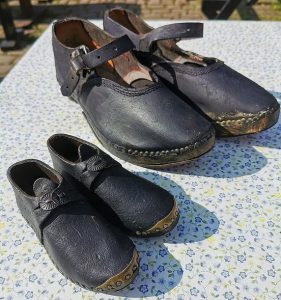 which I’ve yet to use, but will do, soon. That was Clog Experience Pt. 1. The next was a visit to Mytholmroyd, mainly to see Sue and Geoff Mitchell with new CRP Officer Karen. We inspected the work going on to bring the historic station building back to life, and then – special treat – a visit to Walkley’s Clogs. What a delightful treat. Very friendly people, Sue and Alan are clearly clog cranks par excellence and delighted showing me round the shop.
The last bit of the ‘clog saga’ is a piece for The Bolton News, part of which will be used in my forthcoming book Lancastrians. I put a post on facebook asking for stories and anecdotes about clogs and at the last count I had 130 comments. I’ve used a small number for the article, here’s a few, with thanks:
Marjorie Hill recalled: “My brothers wore clogs with steel on the soles which they could make spark by kicking the ground. As the youngest, and only girl I only had one pair with rubber on the bottom. My local cobbler would allow me to watch him make clogs. I still remember the smell of the rubber, glue and polish as I sang to him while he worked. 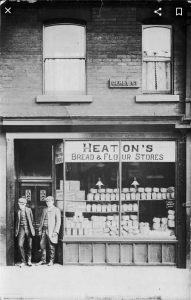 My mother and her friends always wore headscarves when they went out and in the mill wore them as ‘turbans’ to protect their hair from the grease and dangerous machinery. Indoors they always wore wrap-around pinnies, (aprons) with pockets, to keep their clothes clean. This was in the days before washing machines when clothes were scrubbed on a washboard, rinsed in the sink and put through the mangle before being pegged on the line or hung on the hoisted dryer which hung near the fireplace.”
Linda Carroll-Bentley was born in 1953 and lived in Bolton. “I remember having red clogs made for me up to about the age of 4 yrs. Stopped wearing them once I went to school. I remember being taught, by an older child, how to get sparks off the pavement with them! Many of my relatives and friends wore them at that time. I remember a lot of the mill workers wearing them.”
Carole Rimmer Settle: “My brother sent me these Lancashire clogs. We live in Michigan USA. Just love them and hopefully one day to open an antique shop. Named ‘The Lancashire Clog’”
Geoff Proctor is a clog dancer, who is a member of the Britannia Coconut Dancers. He comes from a family of cloggers: “The red clogs were made for my mum about 80yrs ago by her father Jim Butterworth of Smallbridge, Rochdale. He was the president of the association and 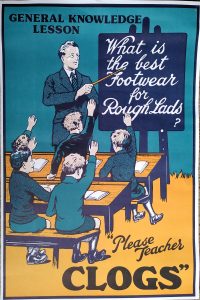 his tools are in York museum. They were given to me on my first birthday and I still cherish them. I wore clogs up to first year in high school but they got banned after sliding a cross the parquet floor in the hall (irons)! My current ones are ‘Sunday Best’ made by Walkleys, which I use for dancing in regularly these days. They’re shod with homemade stainless irons for longevity.”
Denise Hamer recalls: “My Mum wore clogs in the mill and I had a pair when I was young, my husband had a pair to strengthen his ankle when he was young. They had clogs for work and a different style of clog for best.”
Liz Coburn: “This post gives a little more history apropos of the last posting of the video of the cotton mills in Lancashire. These small (5.5 inches) clogs belonged to someone in my grandfather Patrick Hillan’s family. All of his sisters worked in the cotton mills in Bolton, Lancashire, England. The Hillan family was Irish. Many of the Irish settled in the industrial towns of England to find work. These particular clogs are stamped “Lee 1904”. Edwin Lee was a shoe maker whose shop was on 17 Church Bank, Bolton, Lancashire, England. 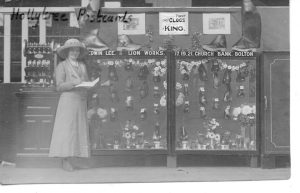 Clogs were worn by the workers in the cotton mills to keep their feet warm and dry. Here comes the interesting part! To alleviate boredom and to warm up, the workers started “Clog Dancing” which involved heavy steps which kept time (clog is Gaelic for ‘time’), and along with striking one shoe with the other, created rhythms and sounds to imitate those made by the milling machinery! Clog Dancing originated as a way of relieving the monotonous labour and physical repetition without being overpowered by the industrial machine.”
Elaine Brooks said “I wore clogs when I first went to school in 1946, mine were black. They had a strap over my instep to fasten them. In winter when walking to school in the snow it built up in between the irons and made you much taller.”
Richard Hoyle: Jack Crawshaw on Miller Barn Lane Waterfoot. Made clogs for the Britannia Coconutters, I think. He used to repair shoes as well and the aroma in his shop of fresh leather was wonderful. “They’ll be ready Tuesday.” was the usual mantra.
Susan Wardle: I am seventy, grew up.in Great Lever. My great uncle worked in Swan Lane Mill until the mid sixties and he wore clogs at work every day
Karen Martindale: I wore clogs to school (born 1959) no one else did. My mum was a good Lancashire girl and took us to get them at a little stall in a market….I think it may have been Bury. Mine were black with bright yellow eyelets they laced up, littler children had red leather ones. They make you walk with a rocking motion because of the rigid sole. The men on the fish market always wore them right up until I left Bolton for Uni. Still got some somewhere.”
Talks, walks and wanderings
Following the ‘official’ end of the Pandemic, I’ve been getting a number of invitations to give talks on various topics. Recent talks have included ‘Allen Clarke’s Bolton’ for Friends of Smithills Hall, ‘Railways and Railwaymen of Turton’ for Turton LHS, ‘Moorlands, Memories and Reflections’ for What’s Your Story, Chorley? and ‘Railways and Communities: Blackrod and Horwich’, for Blackrod LHS. Other topics are:
- The Lancashire Dialect Writing tradition
- The Railways of the North: yesterday, today and tomorrow
- Allen Clarke (1863-1935) Lancashire’s Romantic Radical
- The Winter Hill Mass Trespass of 1896
- The Rise of Socialism and Co-operation in the North
- The Clarion Cycling Clubs and their Club Houses
- Walt Whitman and his Lancashire Friends
- Forgotten Railways of Lancashire
- Banishing Beeching: The Community Rail Movement
- Railways, Railwaymen and Literature
I charge fees that are affordable to the organisation concerned, to fit their budget – so by negotiation. An average fee is in the region of £40-£50, all in.
My preferred geographical location is within 25 miles of Bolton, ideally by train/bus or bike. However, with sufficient notice I can go further afield.
CRANK QUIZ: This week’s Crank Quiz
Clogs were the footwear of choice for many industrial occupations. What distinctive/unusual apparel was worn in the railway industry?
Last Quiz, inspired by Rainford Junction, asked “List station or (actual) signalbox names with ‘Junction’ in their title, which are no longer junctions….Not a huge number of responses but here are nominations from John Yellowlees, of Riccarton Junction: St Helens Jn, Burscough Jn, Dalston Jn, Loughborough Jn no longer operate as junction stations.
READERS’ LETTERS
From Malcolm Bulpitt: Nice summary of ideas on how local rail lines could be made better for both the communities they serve and those who operate them. In it you mention the need for job flexibility to improve efficiency by those who run them. Although I am no supporter of Bozo Boris and his Cabinet of Clowns at least they are outlining the need for the arcane restrictive practices that the operators are currently stuck with must go. Shapps got it wrong though when he referred to ‘Spanish Practices’. Across Europe my fellow transportation professionals refer to similar issues on their systems as the ‘English Way’! Swiss local services have been One-Person-Operated for some 40 years. Ticket offices disappeared on German ‘S-bahn’ & ‘U-bahn’ stations over 30 years ago. Even in the DDR they were going before the Nation went! Many Metro systems across Europe, and the World, are now fully automated. All of these locations have similar good safety records as here. The main reason for the RMT calling the strikes is not to benefit their members, or to give a ‘safer railway’s travellers, but to protect the jobs of the union hierarchy. Reduced staff numbers would result in less members, resulting in less income for the union, and hence less money to furnish the excessive salaries and lifestyles of those at the top. Yes, a pay rise for the members is probably due but here again Boris and Co. have again, surprisingly, got it right. Inflation busting pay rises just fuel inflation. Keep up firing the Salvoes.
Cynthia Dereli writes: Good to hear support for our railways, but perhaps there is a broader context needed for such a discussion now? The climate crisis is not some fairy tale to bring out into conversation for ‘occasions’. It is the reality and should surely be underpinning every argument about how we want to see our society into the future.
So I am not querying the details of your discussion but the lack of urgency and also lack of vision of a better world – where renewable sources are providing the energy for all transport modes and where public transport – transport for the many that is good clean and affordable – plays a major role in delivering a good life for all with no-one left behind while reaching those climate goals to ensure that ‘no-one left behind’ has a global dimension.
New projects
My collection of railway-themed short stories – Last Train from Blackstock Junction – is being published by Platform , this Autumn. It features 12 stories of railway life in the North of England, and has a foreword by Sir Peter Hendy, Chair of Network Rail. More details soon.
Much of my time this year will be devoted to work on one of my biggest projects – a cultural and social history of Lancashire. Lancastrians will be published by Hurst (who recently brought out the fascinating Northumbrians) next year.
Still in Print (at special prices!)
ALLEN CLARKE: Lancashire’s Romantic Radical £9.99 (normally £18.99)
Moorlands, Memories and Reflections £15.00 (£21.00)
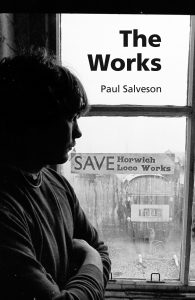
The Works (novel set in Horwich Loco Works) £6 (£12.99)
With Walt Whitman in Bolton £6 (9.99)
See www.lancashireloominary.co.uk for full details of the books (ignore the prices shown and use the above – add total of £4 per order for post and packing in UK)
Stuff happening
The Bolton Station Summer Fair is back on Saturday August 13th, at The Interchange. From 11.00 to mid afternoon; stalls, hopefully a bit of music too.
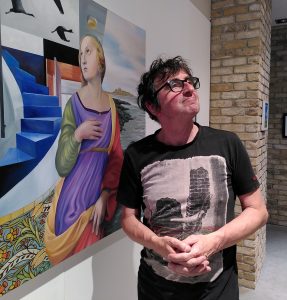 The Hive Gallery in The Market Place, Bolton, is open Friday and Saturday afternoons from 13.00. Currently showing an excellent exhibition of Andy Smith’s work, called ‘Post Modem’ (see pic on left)
Speaking of bees, we launch our Beehive Project in Wigan this Saturday, behind The Swan and Railway pub.
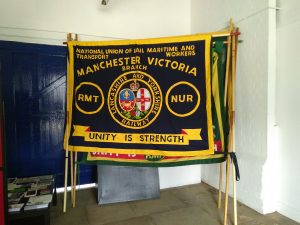 enthusiastically champion the cause of the rail unions, hoping it will embarrass an ailing Tory Government. So far, Labour has tried to ride both horses, seeming to offer sympathy to the rail workers while championing the passengers’ cause.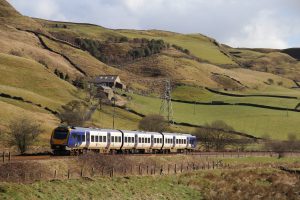
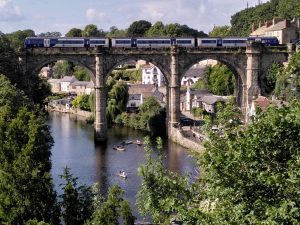 as Esk Valley, Heart of Wales, local branch lines, won’t be getting any trains during strike days as the industry concentrates limited resources on the intercity routes. If it goes on, so much hard work will be lost. Another argument for taking these lines out of the national system and running them as independent social enterprises providing train and bus services (but that’s for another article, see below).
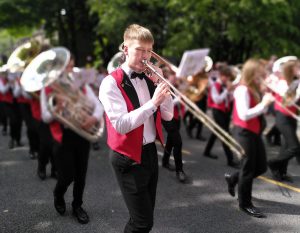 never experienced it, you’re missing something very special and it’s of interest to the transport person as well as a lover of band music. The event takes place in eight villages around the ‘Grater Saddleworth’ area – Delph, Denshaw, Dobcross, Greenfield, Upper Mill , Diggle, Friezeland, Lees and Lydgate. Each band would usually perform at every one, during the evening, starting off just after 4.00. The logistics are fascinating: each band charters its own coach and they move around each location, to a very strict timetable. The local website tells us:
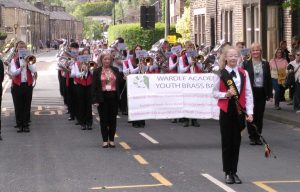 1884, the event has grown in popularity. Now, hundreds of brass bands participate in some twenty different contests at venues scattered around Saddleworth and beyond. All of the contests are open-air, many in delightful surroundings. The area has a very strong tradition of brass band music. In the weeks before Whit Friday, the sounds of rehearsals echo across the hillsides from the various band rooms and village halls. There are thriving bands in some of the tiniest villages. And the best bands are world class. The contests are open to all-comers. So the local youth bands get to match their skills against the top bands of the country. For bandsmen, the dash from contest to contest makes for an exhilarating evening. This is a major event in the brass band calendar and bands travel the length of the country to participate, some even turning up from overseas…..Contests typically start at about 4.30pm. Bands play two pieces (marches), one on the march and then their well-rehearsed
 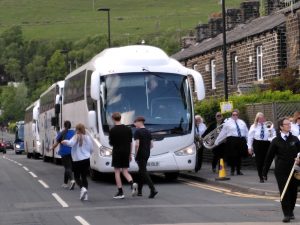 show-piece on whatever passes for a rostrum. Each performance is scored ‘blind’ by an adjudicator, hidden in some adjacent darkened room or caravan. Each contest offers prizes for the best band, best youth band, best soloists etc. At one of the busier venues, you could expect to hear over 50 bands, before the winners are announced shortly after close (10.30 pm or 11.30pm, though the most popular contests can go on well into the early hours).”
 the former Friezeland Loop to watch the first band set off (Wardle Academy) who obliged by playing my favourite march – ‘Slaidburn’ – by Lancashire composer William Rimmer. Magnificent! It really brought tears to my eyes.
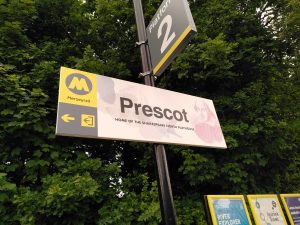 over to North Western and the (currently hourly) stopper to Liverpool was sat waiting. Interestingly, the chap in the coffee kiosk was helpfully telling passengers to use the front three cars of the 6-car 331 formation. And his coffee was very nice too. We let the Blackpool – Liverpool ‘fast’ depart and we set off on time, past Springs Branch and through the old mining country around Bamfurlong and Ince Moss.Much of this used to be quadruple track, with heavy coal traffic from the local pits between Wigan, Bryn and Garswood. There are still some traces of it. The local stations – Bryn, then Garswood, were busy with people going into Liverpool for the day. I got out at Prescot, a place I must confess to never having set foot before. The booking office wasn’t busy so I I tried out the quality of local information, asking how to walk up to the town centre. The chap on duty couldn’t have been more helpful, and excellent ambassador for Northern but also for Prescot. The Station House cafe was open but after my coffee and cake at Wigan I reluctantly gave it a miss – but will go back and try it out.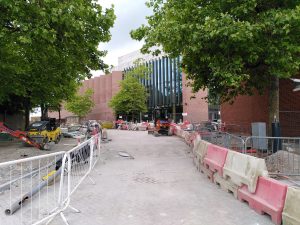
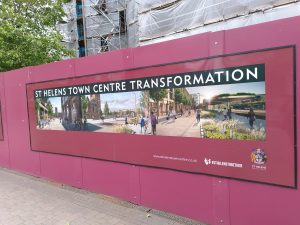 Street. It’s well worth a visit and the coffee is recommended. There’s quite a lot going on in the town centre with a major regeneration project in the town hall area. The enormous Gamble Building is being restored and should open next year.
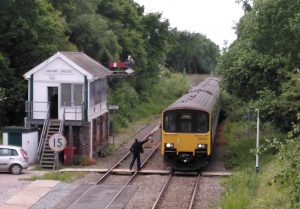 special routed via Wigan, St Helens, Earlestown and Warrington and was hauled, appropriately I suppose, by LMS Jubilee ‘Seahorse’. I wasn’t going to watch the horses, apart from that one, but doing a spotting trip with my dad. It was my first sighting of Great Western locos, with Chester West shed being full of ‘Halls’ and ‘Granges’. The line from Rainford Junction had long been closed to regular passenger services and the tracks were overgrown. Must have been about 1960.
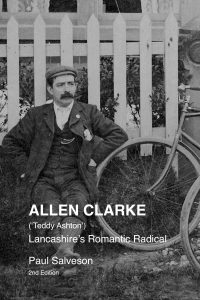 delivery). The book is substantially up-dated from the 2009 edition and has a lot of new material in it, including an entirely new chapter on Clarke’s railway writings. You can download an order form from my website, below, or there’s one at the back of this newsletter: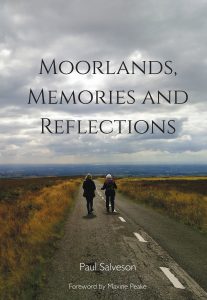
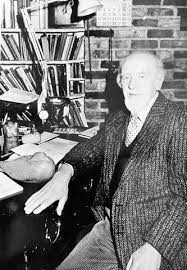
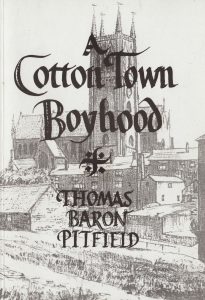 Altrincham. Although in a leafy Cheshire suburb, Thomas retained a strong sense of his Bolton roots and the first volume of his autobiography is titled A Cotton Town Boyhood. It features some entertaining examples of his Lancashire dialect poetry, including an introduction to his ‘Overture on North Country Tunes’, composed for the coronation in 1953 and performed on the BBC ‘regional’ radio station. He became-president of Bolton Musical Artists Association.
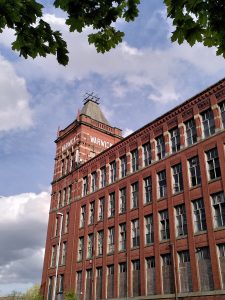
 The adjacent external area plans to be opened up for commercial, food and drink uses, with new publicly accessible open spaces. The plans will see the demolition of the derelict London House to bring forward a new high-quality residential development, integrated with the mill. The mill’s owners have been working with Rochdale Borough Council and Historic England to create a scheme that sympathetically restores the mill and delivers new development to achieve a viable scheme.”
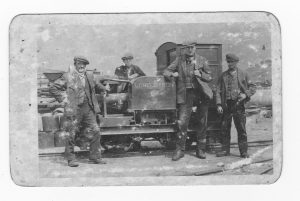
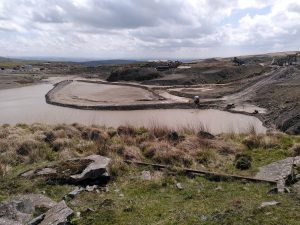 We even found a bit of old track. We walked back via Lee Quarry – huge, but disused. We ended up back at the ‘Lancashire Sock Manufacturing Company’ – or these days just ‘Lancashire Sock’. It’s a good example of how a traditional business has adapted, and seems to be doing well. Its website tells us: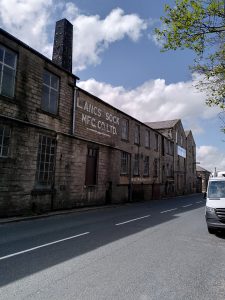
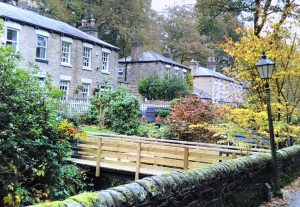

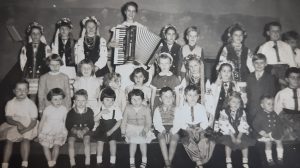
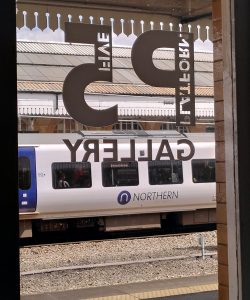
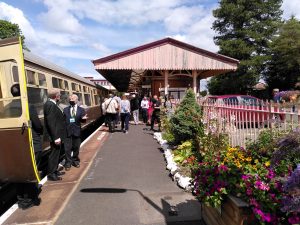
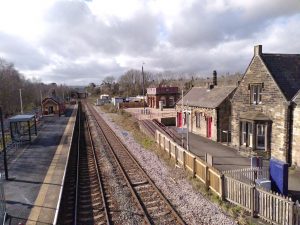 What a transformation at this historic station! Buildings –including water tower, booking office, waiting rooms and signalbox –have been brought back into use, gardens created and a general sense of ‘well-being’ (a much over-used term I know) created. Haltwhistle itself is a delightful town. A real ‘town’ rather than village, with pubs, shops and library. The location, along the River Tyne, couldn’t be better. The station acts as a barrier between town and river; the south side of the tracks take you down to a magnificent bridge across the river and out to open country. Only wish I’d had more time to explore, but there’s always a second time. Thank to my hosts for their company, conversation and lunch!

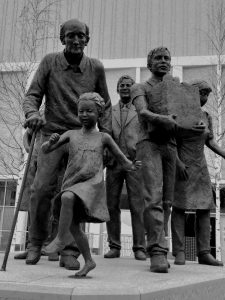
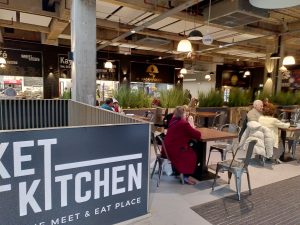 done with the Market Kitchen – a large open eating space with lots of food outlets – ranging from your traditional hearty Barnsley fare to Thai, Greek, Indian and more. Up the hill, past the splendid town hall (now home to Experiencing Barnsley local history museum) is The Cooper Gallery which has lots of good material and a nice cafe (where I once met Dickie Bird, who is celebrated in a nearby statue, even though he’s still alive).
 other things to interest the visitor. The Heritage Centre website says that following the surrender of the lease by the trustees of Elsecar Heritage Railway in August 2020, combined with the Pandemic, the future of the railway is under review and a consultation process will start very shortly. Let’s hope the railway will return, it’s an important part of what the heritage centre offers.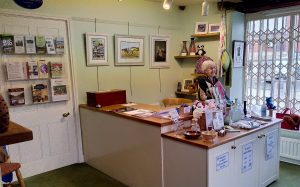
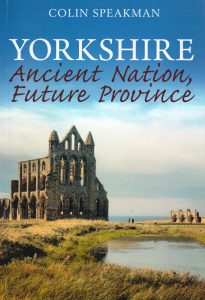 on the importance of leisure transport. I think it’s fair to say that he has developed an unrivalled knowledge of his adopted shire, bringing all the zeal of a convert to his work, not least for The Yorkshire Society.